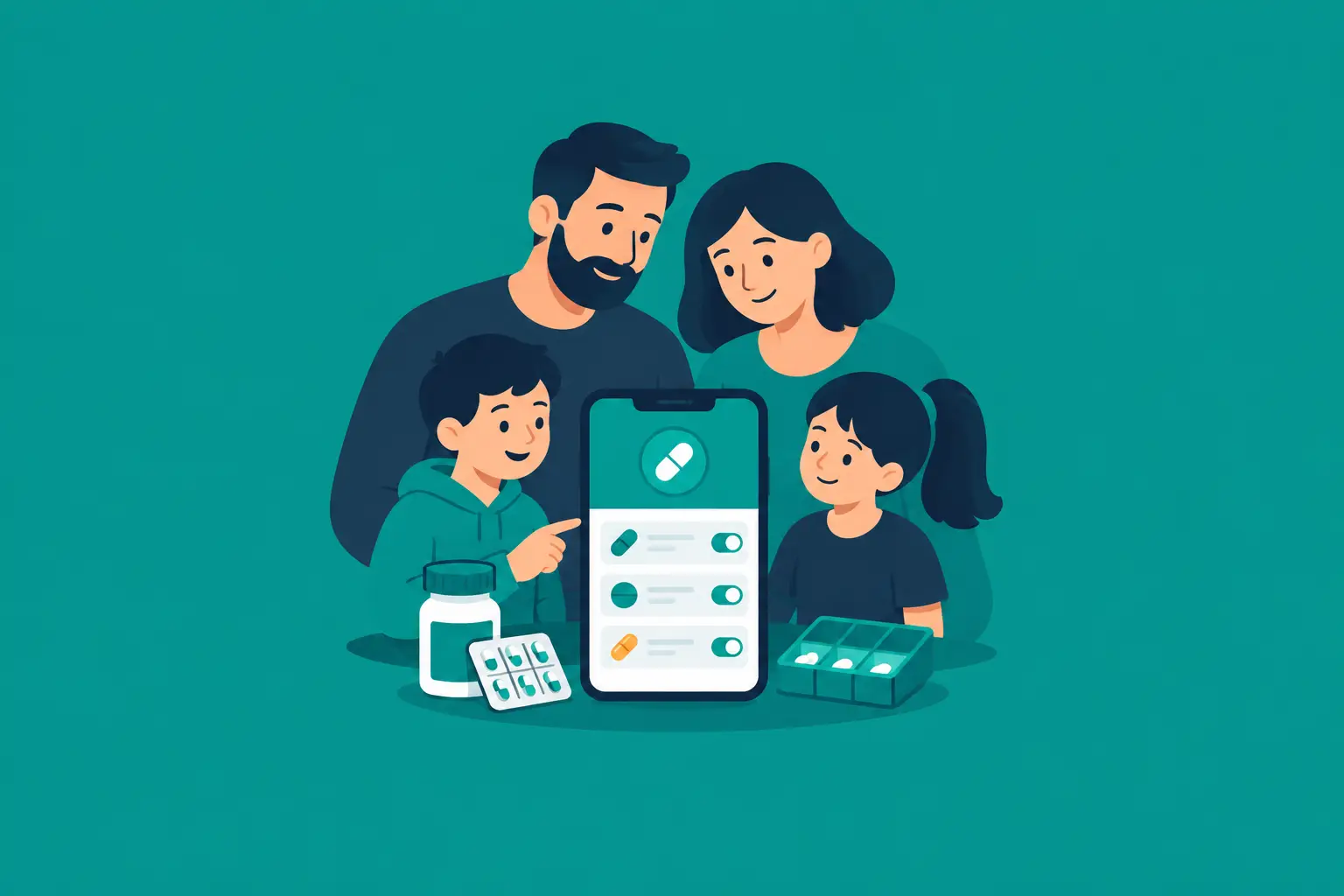
A sick child wakes at 2:00 a.m. A grandparent has a morning routine. One parent is traveling, while another caregiver is handling pickup and bedtime. The hard part is often not caring deeply enough. It is knowing, with confidence, what has already happened and what still needs attention. This family medication tracking example shows how one shared household record can replace scattered notes, text messages, and memory-based handoffs.
This is not medical advice or a replacement for instructions from a healthcare professional or pharmacist. It is a practical example of how a family can organize the information they are already responsible for tracking.
Why families need one shared record
Medication tracking becomes harder when care is spread across people, schedules, and rooms of the house. A bottle on the counter may tell you what a medication is, but it does not reliably show whether it was logged, when it was last given, or whether another caregiver is planning to handle the next routine.
That uncertainty creates unnecessary pressure. During a routine week, it can lead to missed reminders or duplicate work. When illness strikes, it can turn a simple question - “When was that last recorded?” - into a scramble through texts, paper notes, and tired recollections.
A useful household system creates one source of truth. Each family member has their own profile, every entry is time-stamped, and authorized caregivers can see the same current information. The goal is not to make family care feel clinical. It is to make the next step clear.
A family medication tracking example for a busy household
Consider the Rivera household: Jordan and Casey are parents of six-year-old Mia and twelve-year-old Noah. Casey also helps coordinate care for Jordan’s father, Luis, who lives nearby. The family has ordinary weekday routines, but the people responsible for care change often.
Jordan handles mornings. Casey usually manages afternoons and bedtime. A babysitter covers one evening each week, and Luis sometimes stays with the family on weekends. Before they use a shared tracker, their system is a mix of calendar alarms, a note on the refrigerator, and text messages such as “Did anyone log this?”
Their organized record has four simple parts: individual family profiles, recurring routines, as-needed medication timers, and health-reading logs. Each part answers a different question without asking a caregiver to search through unrelated information.
1. Separate profiles prevent mix-ups
Mia, Noah, and Luis each have an individual profile. Their records are not combined into one long household list. This matters because names, instructions, routines, and health observations should stay connected to the correct person.
When Jordan opens Mia’s profile, Jordan sees only Mia’s active routine items, recent logs, and illness-related notes. When Casey switches to Luis’s profile, Luis’s information is separate and easy to review. A clear profile structure reduces the chance that a busy caregiver records an item under the wrong family member or assumes a reminder belongs to someone else.
For households with multiple children, this small distinction can make a major difference. Similar bottles, rushed mornings, and interrupted evenings are exactly when a clean visual separation earns its place.
2. Recurring routines make the day easier to hand off
The Rivera family enters recurring medication routines exactly as provided by their care instructions. Rather than relying on one person to remember each routine, the tracker creates reminders at the appropriate times and records completion when a caregiver logs it.
At 7:15 a.m., Jordan receives a reminder for Mia’s routine. Jordan opens Mia’s profile, confirms the entry, and the record reflects the time and caregiver. Later, Casey can see that the morning item is complete without sending a message or searching for a note.
This is especially helpful when a routine falls near a transition: school drop-off, daycare pickup, a commute, or bedtime. The reminder is useful, but the documented completion is what creates confidence for the next caregiver.
A paper chart can work for one person and one schedule. It becomes less dependable when the chart is not nearby, handwriting is unclear, or a caregiver forgets to update it. Digital tracking is not about adding more screens to family life. It is about reducing the number of places a caregiver has to check.
3. As-needed timers make timing visible
One evening, Mia is not feeling well. The family starts an illness tracking session in her profile and uses an as-needed medication timer after logging an entry according to the instructions they have been given. The timer shows when that entry was recorded and when the next eligible time window may be reached based on the household’s configured schedule.
The value is not in telling a caregiver what to give or when to make a medical decision. The value is in making the family’s own documented timing visible to every authorized caregiver.
Casey is at an appointment while Jordan is home with Mia. Instead of calling Casey to reconstruct the evening, Jordan checks the shared record. If a caregiver has a question about the instructions, symptoms, or what action is appropriate, the record provides a clear history to reference when contacting the appropriate healthcare resource.
This feature is also useful when more than one adult is awake during a difficult night. A timer removes the need to trust a tired memory. It replaces “I think it was around midnight” with a time-stamped entry that everyone can see.
4. Health readings and observations stay in context
The Rivera family uses Mia’s illness session to log health readings and brief observations over time. They record the reading, the time, and a short note such as “resting on the couch” or “returned from school.” These notes are not a diagnosis. They are a clear household history.
Context matters. A single number or a vague text message does not always tell another caregiver much. A time-stamped series of readings and observations can help the family see what has been recorded during the day and communicate more accurately if they need professional guidance.
The best notes are short and factual. Avoid trying to interpret every change in the log. The purpose is to preserve what was observed, not to turn a family tracker into a medical chart.
What the shared view looks like at handoff time
At 5:30 p.m., Casey takes over from Jordan. Instead of asking several open-ended questions, Casey opens the household view and quickly sees Mia’s morning routine marked complete, the current illness session, the most recent health reading, and the status of the active timer. Luis’s profile shows his separate routine status for the day.
That handoff is brief because the record is current. The family can still talk about how everyone is doing, but they do not have to rebuild a timeline from memory first.
A strong family tracker should make these details obvious: who the entry belongs to, what was logged, when it was logged, and which caregiver recorded it. If a system hides those basics behind too many screens, it may create friction at precisely the moment a family needs clarity.
Set up a tracker around real household behavior
The most effective setup is usually the simplest one the family will actually maintain. Start with the people who need separate records, then add the routines that are most likely to be missed or questioned. Invite only the caregivers who genuinely need access, and agree that every person will log an entry as soon as they complete it.
Consistency matters more than perfect detail. A tracker filled with elaborate notes for two days and abandoned on the third does not create peace of mind. A straightforward record that is updated in real time is more useful during a handoff, a busy morning, or a stressful illness episode.
It also helps to decide what belongs in the system. Medication routines, as-needed timing, health readings, and brief observations are natural categories. Long family discussions, unrelated appointments, and uncertain assumptions usually belong somewhere else. Keeping the record focused makes it easier to trust.
Privacy is part of family safety
Family health information deserves more care than a shared note app or a thread of messages that can be lost, forwarded, or read out of context. Before choosing a tracking tool, families should understand who can access each profile, how caregiver sharing works, and whether the service uses health data for advertising or sale.
Medication Timer is designed as a private family health utility, with shared household coordination, individual profiles, medication timers, and illness tracking in one trusted place. The practical benefit is simple: caregivers can stay aligned without making sensitive information harder to protect.
The right system will not remove every stressful moment. It can, however, give a tired parent, a co-caregiver, or a concerned adult a reliable place to look before they have to rely on memory. Every clear entry is a small act of care that makes the next handoff calmer.