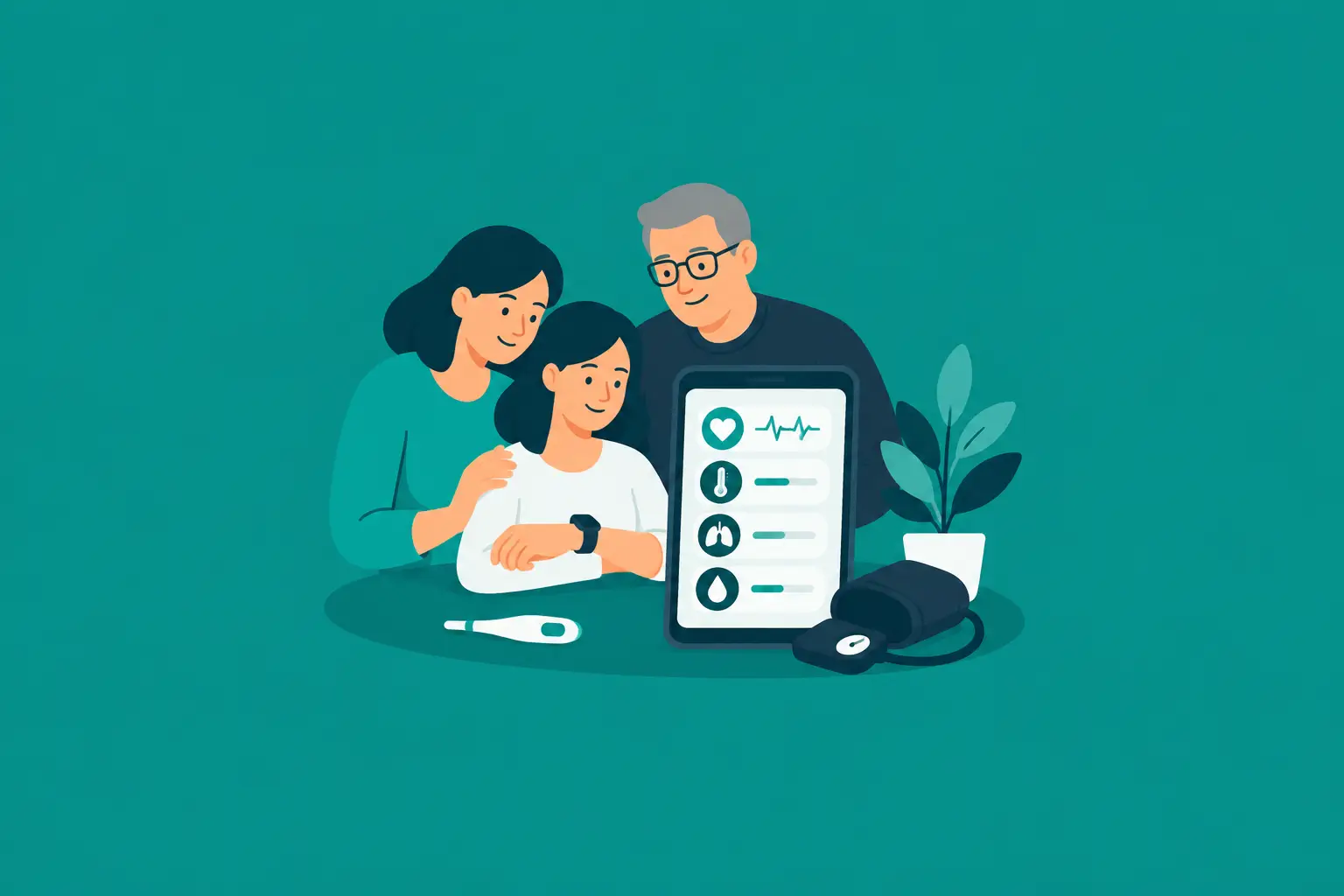
A reading taken at home is only useful if the right person can find it later. When one caregiver checks a temperature before work, another is handling bedtime, and a third is messaging from across town, a note in someone’s phone or a number recalled from memory can quickly create confusion. This home vital sign logging guide is built for the practical part of family care: creating one clear, shared record without turning your household into a clinic.
Logging is not about making a diagnosis or replacing professional care. It is about preserving accurate information, reducing repeated questions, and giving caregivers a dependable timeline when illness or routine monitoring puts everyone under pressure.
Why a shared log brings calm to busy households
Family health information often ends up scattered across paper notes, text threads, refrigerator calendars, and separate apps. That setup may work for one person on a quiet day. It becomes much harder when multiple people are caring for a child, a partner, or an older relative.
A centralized log gives each reading context. Instead of seeing a number with no explanation, a caregiver can see who recorded it, when it was recorded, how it was measured, and what else was happening at the time. That context helps the household communicate clearly without relying on memory.
The value is especially clear during an illness. Readings may be taken at different times, symptoms may change, and caregivers may rotate responsibilities. A simple timeline keeps the story together. It also saves the family from the common question: “Do you remember what the last reading was?”
Start your home vital sign logging guide with a simple routine
The best logging system is one your household can use when people are tired, worried, or rushing out the door. Start with a consistent process rather than trying to capture every possible detail.
First, decide who needs a profile or dedicated record. This matters in homes with more than one child, shared caregiving, or relatives who receive support. Every entry should be tied to one family member. A perfectly recorded reading attached to the wrong person is not helpful.
Next, choose one trusted place for entries. A family health platform such as Medication Timer can keep health readings, medication schedules, illness tracking, and caregiver coordination in one household-centered record. Whatever system you choose, the rule should be simple: record the reading there, not in a private text message or a loose note that may disappear.
Finally, agree on when to log. Some households log readings as part of an established routine. Others only begin a focused log when someone is unwell or when they are following a care plan from a health professional. The right approach depends on your family’s needs. Consistency matters more than complexity.
What each entry should include
A useful entry needs enough detail to be understood later, even by someone who was not present. Capture the basics in the same order each time:
- The family member’s name or profile
- The date and exact time of the reading
- The type of reading recorded
- The measurement and unit shown by the device
- The method or device used, when relevant
- A brief note about symptoms, activity, or circumstances
- The caregiver who entered it, if several people share care
That last bit of context can prevent needless uncertainty. A short note such as “after waking,” “resting,” or “reported feeling uncomfortable” is more useful than a long narrative. Keep notes factual and neutral. The goal is a clean record, not an interpretation of what the reading means.
Build a record people can trust
Reliable tracking starts before the number reaches the log. Enter what the device displays, including its unit, rather than rounding from memory or changing the value to make it look neater. If a reading must be entered later, mark the time it was actually taken, not just the time it was added.
It also helps to use the same name for the same kind of reading each time. For example, avoid alternating between vague labels such as “check,” “stats,” and “reading.” Clear labels make a timeline easier to scan and reduce mix-ups when caregivers are looking at past entries quickly.
If you use more than one device or measurement method, record that detail consistently. Different devices, settings, and methods can produce records that are harder to compare without context. The log does not need to explain why a difference happened. It simply needs to preserve an accurate account of what was recorded and how.
Correcting an entry is better than silently working around it. If you discover the wrong family member, time, or number was entered, update the record when your system allows it and add a brief clarification if needed. A trustworthy log is not one with no mistakes. It is one where mistakes do not remain hidden.
Keep caregiver communication separate from guesswork
A shared log should reduce handoff friction. At the start of a shift, before school pickup, or when one caregiver is taking over overnight responsibilities, the incoming person should be able to review the latest entries without reconstructing the day from messages.
Use the log for facts, then use your usual communication channel for decisions and questions. This distinction is helpful. A record might show what was measured and when, while a message can say that a caregiver has seen the update or that the family needs to check its next step with an appropriate health professional.
Avoid using a log as a place for informal conclusions. Phrases such as “fine now” or “nothing to worry about” can be misleading when viewed later by someone who lacks the full context. Factual notes protect clarity: what happened, when it happened, and who observed it.
For shared households, set a few simple operating rules. The person who takes the reading logs it as soon as practical. Anyone who sees a new entry checks the timestamp before assuming it is the most recent one. And caregivers do not delete information simply because the situation appears to have settled. The earlier record may still be useful for understanding the full timeline.
Use illness-specific tracking without creating clutter
When illness strikes, routine family organization can shift quickly. A dedicated tracking session can keep that period separate from ordinary, ongoing records. It gives caregivers one place to see readings, symptoms, notes, and related household care tasks in chronological order.
Keep an illness session focused on relevant observations. Adding every unrelated detail can make the record harder to read, especially if someone needs to share a concise history with a health professional. A short, time-stamped trail is usually more useful than a crowded journal.
At the end of the episode, preserve the record rather than treating it as disposable. Past logs can help caregivers remember what occurred, identify what information was already shared, and prepare for future conversations. They are household records, not predictions about what will happen next.
Protect privacy while making information available
Family health logs contain personal information. Convenience should not mean sending sensitive details across every text thread or storing them in places others can easily access. Choose a system with household-specific access controls, and share access only with people who actively participate in care.
Privacy also supports accuracy. When caregivers know there is one protected, trusted place to record information, they are less likely to create duplicate notes across personal devices. Fewer copies mean fewer conflicting versions of the same event.
Review access when family circumstances change. A babysitter, visiting relative, or former helper may no longer need visibility into household health information. Keeping access current is a small administrative step that supports the safety and dignity of every family member.
Make the log useful when someone asks for details
A well-kept log can make conversations with a health professional more organized. Before a call or visit, review the timeline and bring the factual record: dates, times, measurements, methods, symptoms observed, and relevant household notes. Do not rely on a recreated story if the original record is available.
The log itself does not tell you what action to take, and it should not be used as a substitute for professional guidance. Follow the instructions you have been given for the person in your care, and use appropriate professional or emergency support whenever the situation calls for it.
The quiet benefit of a family log is that it removes one burden from a stressful moment. Instead of searching through messages or asking everyone what they remember, you have a shared record that respects the details. Every reading has a place, every caregiver can stay aligned, and your family can focus on care with a little more peace of mind.