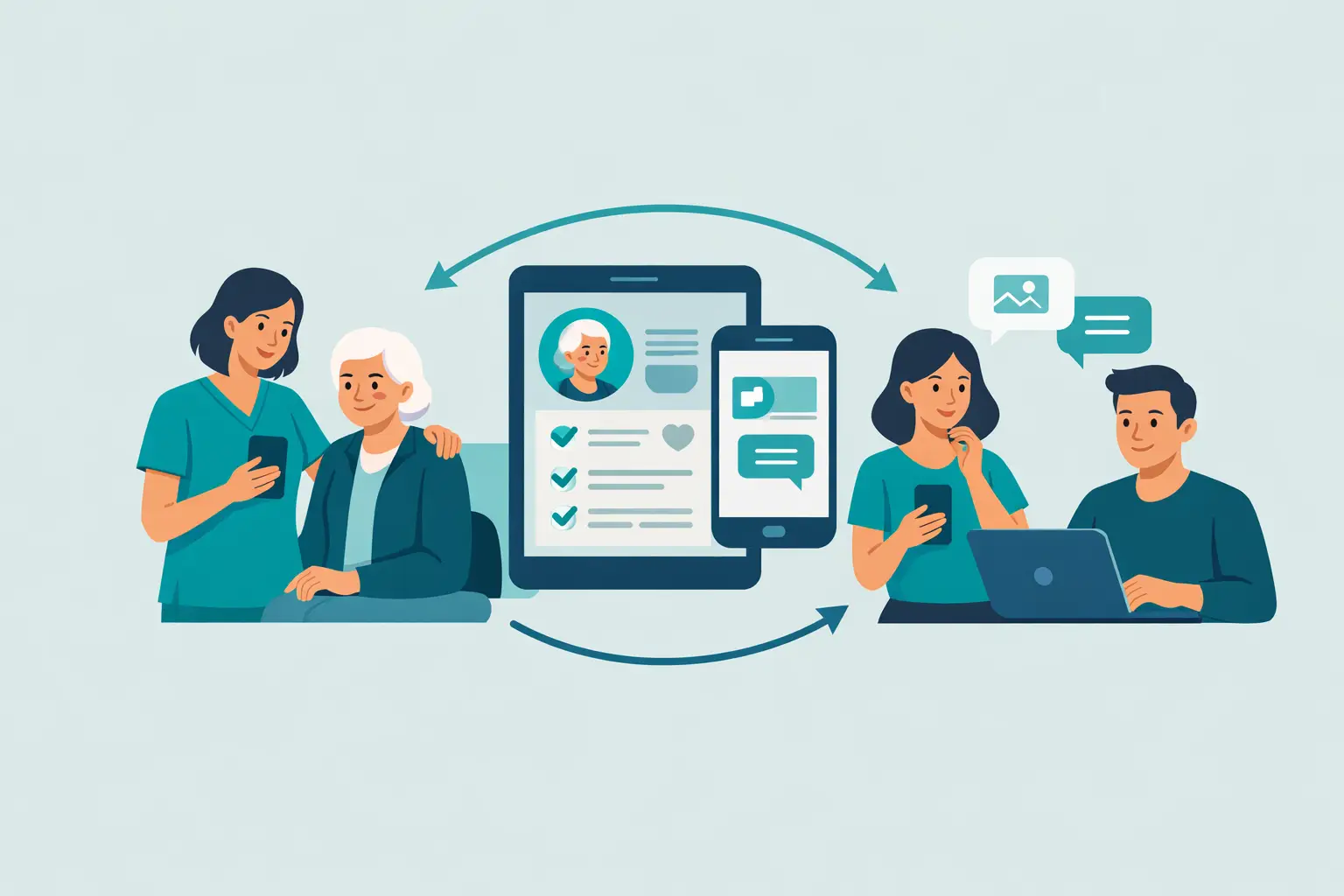
A child develops a fever while one parent is at work. A grandparent is covering the afternoon. Another caregiver handled the morning routine. By dinner, everyone is trying to reconstruct what happened, when it happened, and what still needs attention. The stress rarely comes from a lack of care. It comes from scattered information.
Learning how to share caregiver updates gives families a calmer way to coordinate. The goal is not to turn home care into a clinical chart. It is to make sure the people responsible for a family member have the same clear, current picture - without repeated texts, guesswork, or avoidable confusion.
Start with one shared source of truth
Care updates become unreliable when they live in too many places. A text thread may contain an important note, a paper log may sit on the kitchen counter, and a reminder may be set on only one person's phone. Each method can work briefly, but together they create gaps.
Choose one trusted place where authorized caregivers can see the current routine, completed tasks, logged readings, observations, and upcoming responsibilities. For a household, that might be a family care app, a shared digital record, or another private system everyone agrees to check.
The system matters less than the habit. Everyone should know where an update belongs and where to look before asking, "Has this already been done?" A single source of truth reduces duplicate work and helps prevent one caregiver from acting on outdated information.
This is especially useful when care changes hands during a busy day. The caregiver leaving does not need to remember every detail later. The caregiver arriving does not need to piece together a story from incomplete messages.
How to share caregiver updates that people can use
A helpful update is short, factual, and easy for another person to act on. It answers the questions a caregiver is most likely to have when they open it: What happened? When did it happen? What is already complete? What should I watch or handle next?
Vague notes create follow-up questions. "Doing better" may be reassuring, but it does not tell another caregiver what has changed. A clearer update might say that a reading was logged at a specific time, a routine item was completed, a family member rested, or a scheduled task remains for later. Keep the wording focused on observable information rather than assumptions.
For example, instead of writing, "Everything is fine," try: "Temperature logged at 2:15 p.m. Afternoon routine completed. Resting now. Please check the shared schedule before the evening handoff." The update is still brief, but it gives the next caregiver a useful starting point.
Include time stamps whenever timing matters
In family care, timing is often the detail that prevents uncertainty. A note without a time can force caregivers to search messages or rely on memory. Record when an item was completed, when a reading was taken, when symptoms or behavior changed, or when a caregiver started and ended coverage.
A time stamp is not about creating more work. It preserves context. "Ate lunch" and "ate lunch at 12:30 p.m." may mean very different things to the person coordinating the rest of the day.
Separate facts from follow-up needs
An update can include both what happened and what remains, but those should be easy to distinguish. Facts might include a completed routine, a logged observation, or a change in schedule. Follow-up needs might include checking the shared record, bringing a needed item, or confirming who is covering the next handoff.
This distinction keeps updates from becoming long messages that hide the one task another caregiver needs to see. If a handoff has several moving parts, use short labeled lines rather than a dense paragraph.
Build a simple handoff rhythm
The best update system fits into real family life. Most households do not need constant reporting. They need predictable moments when information is reviewed and responsibilities are clear.
A useful rhythm may include a quick morning check, an update when caregiving changes hands, and an evening review. During an illness or a period with more frequent routines, updates may happen more often. The right frequency depends on the family member's needs, the number of caregivers involved, and how quickly plans are changing.
Agree on what deserves an immediate update versus what can wait until the next handoff. A completed recurring task may only need to be logged. A schedule change, a new observation, or an unexpected disruption may need a direct message in addition to the shared record. This prevents notification fatigue while keeping the important details visible.
It also helps to name the next responsible person. Rather than leaving a note that says, "Needs attention later," write who plans to check in and when. Clear ownership is kinder to caregivers because no one has to wonder whether someone else is handling it.
Use a consistent update format
Caregiver updates are easier to scan when they follow the same pattern. Families can use a simple four-part structure:
- Time: When the update or event occurred.
- Status: What was completed, observed, or changed.
- Next step: What still needs to happen or be checked.
- Owner: Who is responsible for the next handoff or task.
Not every update needs all four parts. A quick log may only need time and status. But when several caregivers are coordinating, this structure keeps the essential details from getting lost.
Consistency is more valuable than perfect wording. A babysitter, co-parent, adult sibling, or neighbor should be able to understand the record without learning a complicated system. Use familiar terms, plain language, and household labels that everyone recognizes.
Protect privacy while keeping care connected
Caregiving information is personal, even within a close family. Share only with people who genuinely need access, and review access when a caregiving arrangement changes. A former sitter, temporary helper, or extended family member should not automatically keep seeing household health details once their role ends.
Avoid putting sensitive information in broad group chats where it can be forwarded, buried, or viewed by people outside the care circle. A privacy-forward shared platform can give families more control than a long-running text thread, particularly when several people need visibility into routines and logs.
Privacy and coordination are not competing goals. The right setup supports both: caregivers receive the information needed to do their part, while the family keeps personal details in a trusted place.
Plan for the moments when nobody is available
Caregiver updates are most valuable when life is not running on schedule. Phones run out of battery. A parent gets pulled into a meeting. A caregiver forgets to mention a change during a rushed pickup. Your system should still make the current status easy to find.
Set basic household expectations in advance. Decide where updates are recorded, who has access, what information should be time-stamped, and how caregivers signal a handoff. Keep the process simple enough that someone can use it when tired or distracted.
It is also wise to avoid relying on a single person's memory. If one family member usually manages everything, shared visibility can provide backup without taking away their role. Another caregiver can confirm the plan, see what is complete, and step in with confidence when needed.
Medication Timer is designed around this kind of shared family coordination, bringing routines, medication tracking, readings, and caregiver visibility into one private household space. The practical benefit is less time chasing updates and more confidence that each caregiver is working from the same record.
Keep the tone supportive, not supervisory
A shared record should help caregivers feel prepared, not watched. This matters in families where responsibilities are divided between parents, grandparents, adult children, or professional helpers. Updates work best when they are treated as a courtesy to the next person, not a test of whether someone did enough.
Use neutral language. Thank people for logging information. Clarify a missing detail without blame. If the process is not working, adjust the system rather than expecting everyone to remember a more complicated set of rules.
The clearest caregiver update is often the simplest one: what happened, when it happened, and what comes next. When that information has one trusted home, families can spend less energy coordinating care and more energy being present for one another.