
Just before the school run, one parent is pulling on shoes while the other calls from the hallway, "Did she have her morning medicine?" Nobody is quite sure. One thought the other gave it, the other was in the shower, and a grandparent is taking over in the afternoon. A medicine schedule can look simple until care is shared. Then the key question is not just what needs to happen. It is whether it already happened, who logged it and what comes next.
For families, medicine schedules are less about building a perfect chart and more about a dependable system. The right system cuts avoidable guesswork, keeps household routines visible and gives every caregiver the same source of truth when the day gets busy.
Why family medicine schedules break down
Most schedule problems are not caused by a lack of care. They happen because care lives in too many places: a reminder on one person's phone, directions on a package, a scrap of paper on the bench, a text between caregivers and a half-remembered conversation from earlier that morning.
That approach may hold up when one person manages one routine. It gets fragile when several family members, changing daily plans or a sick day enter the picture. A caregiver may see a reminder but not know whether someone else already handled it. Another may need to leave the house with no clear way to hand over where things stand.
The result is a mental load that follows families everywhere. Instead of feeling organised, caregivers keep checking, asking and trying to piece together what happened. A clear schedule replaces that guesswork with a shared record.
What a useful medicine schedule should show
A schedule should be easy to read at a glance, especially when someone is tired, distracted or stepping in to help. The goal is not to turn household care into a clinic. It is to make the current status and the next step clear.
At minimum, each routine should belong to the right family member and show its timing and whether it has been taken. A strong system also separates recurring routines from as-needed medicines, because they are different jobs and should not be squeezed into the same confusing format.
In Medication Timer, Today lays this out for the whole household: each family member's routines, doses and readings for the day, with what has been taken and what is still due (Free).
Recurring routines need consistency
Recurring items follow a regular pattern. What matters most is that the schedule reflects the family's real life. If mornings are hectic, a vague reminder that is easy to swipe away may not be enough. A visible routine with a clear taken status gives caregivers a better way to confirm what has been handled.
Medication Timer handles daily, weekly or hourly dose routines, plus health reading routines such as blood pressure or INR, for each family member, with a notification when something is due and Take or Snooze right on Today (Free + more with Family Care). The free plan covers up to three routines and enabled readings combined per family member (twelve across the household), and Family Care removes those limits.
Consistency also makes handovers easier. A partner or grandparent who shares the household does not need to decode a handwritten system or scroll back through texts. They can see the routine and log the dose in the same place.
As-needed medicines need a clear countdown
As-needed medicines bring a different kind of pressure. Families need a clear record of when a dose was given and how long is left before the next one is due. You log an as-needed dose when you give it, and the timer counts down against the minimum interval and daily limit your household set from the pharmacy label or your clinician's instructions (Free). With Family Care sharing, a quiet line on shared timers shows who logged the last dose and when (Family Care).
The practical difference matters. A recurring routine helps people remember a planned dose. An as-needed timer shows what has already been logged before the next caregiver steps in. Keeping the two separate makes the record far easier to trust. The timer does not make decisions for your family. It keeps the routine you already follow visible.
Build medicine schedules around people, not just reminders
A household does not have one schedule. It has several people with different routines, needs and caregivers. Lumping everything into one generic list lets names, similar medicines and overlapping reminders blur together.
Start by giving each family member their own place in the record. In Medication Timer, you add each person as a family member, and their routines, doses and health readings stay with them. That simple structure makes it easier to answer the questions that matter: whose routine is this, what was logged and what still needs attention?
Next, decide who is helping. Shared care works best when the people looking after a family member work from the same current information. In Medication Timer, sharing the household is part of Family Care. You invite each caregiver from Sharing & Access in Profile, and everyone signs in with their own account and works from the same routines, doses and readings. Our guide on whether two parents can track medications together covers this in more detail.
Privacy belongs in this conversation too. Family health information is personal, so keep it in one trusted place rather than in scattered messages or shared passwords. Both Medication Timer plans have no ads, and your family's health data is never sold. You can read more about why we keep it ad-free.
Create a schedule that survives a busy day
The best plan is the one your household can actually use on school mornings, travel days, late work nights and sick days. Start small. Move current routines out of memory and into one shared record before trying to capture every possible detail.
A practical setup usually comes down to four habits:
- Assign every routine to the right family member.
- Use medicine names that every caregiver will recognise quickly.
- Log a dose when it happens, rather than relying on memory later.
- Keep health readings with the same family member's record.
These habits build a useful history without piling admin onto caregivers. The record should support the care, not become another job that slips through the cracks.
It also helps to make taken doses visible. A reminder on its own answers only one question: something was planned. A logged dose answers the more useful one: was it handled? When more than one caregiver is involved, that difference removes a lot of uncertainty.
The same goes for errands. When a pack looks light, you can flag that medicine Running low, and the cue stays on its timers and medication card until someone clears it (Free + more with Family Care). On iPhone and Android, Family Care also puts flagged medicines on the shared To pick up list, so whoever passes the pharmacy can tick them off (Family Care). It is a flag you set yourself, not stock tracking.
Use Care to keep sick days together
When illness strikes, the schedule is only one part of the story. Families may also be tracking temperatures, symptoms, fluids and sleep, and want them handy for whoever is caring next. Spread across scraps of paper, phone photos and conversations, those details are hard to read as a pattern or pass on cleanly at a handover.
In Medication Timer, that is what Care is for (Free). Tap Start care and choose the family member who is unwell, then log doses, temperatures, symptoms and quick wellness check-ins such as hydration, eating, sleep and mood as they happen. Everything lands on one timeline for that person, in order, and Next up shows what needs attention now, such as a temperature check that is due or a timer still counting down.
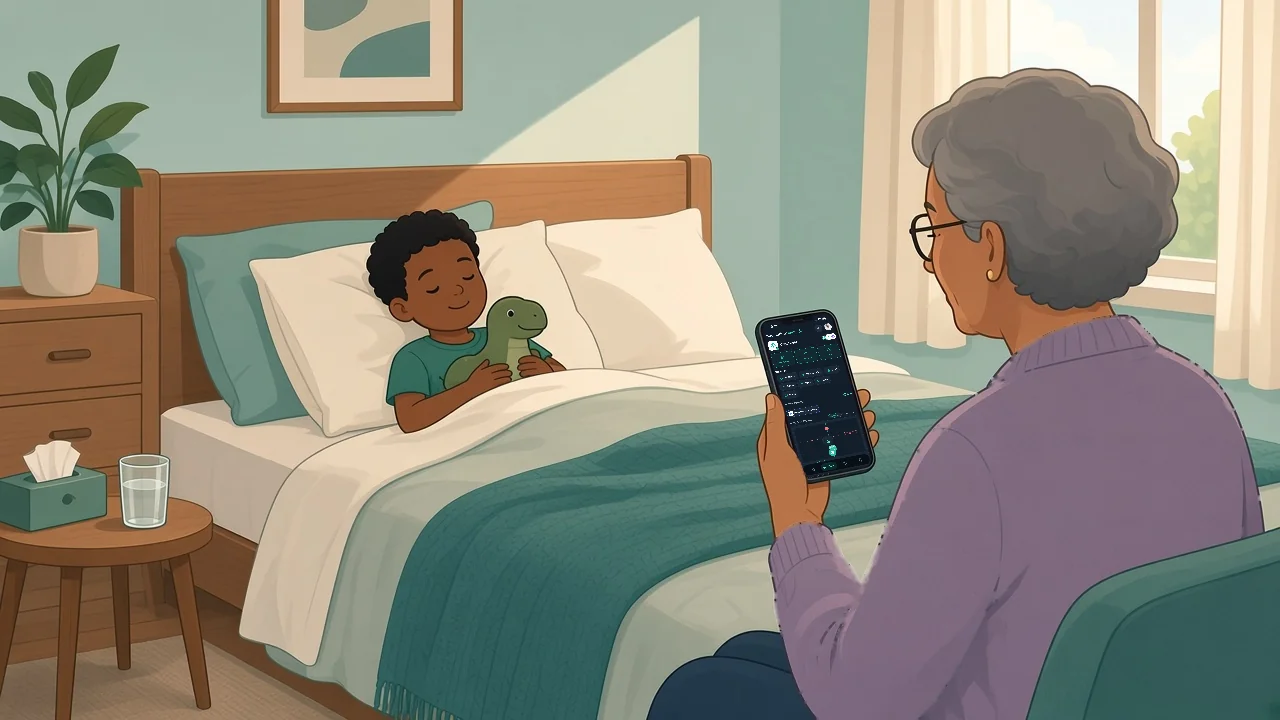
This helps most overnight or across several days, when caregivers take turns and details start to blur. On iPhone and Android, other caregivers sharing the household get a Care started notification when someone starts a session (Family Care). If you are heading to a GP or pharmacist, family reports turn doses, readings and symptoms into a clear summary you can bring along (Family Care).
Make caregiver handovers part of the routine
Many household mix-ups happen at transitions: one adult leaves for work, a child goes to their other home, a grandparent covers an afternoon, or a partner assumes the other person has already seen an update. A schedule is only as dependable as the handover around it.
Before a transition, the outgoing caregiver logs what has been given. The incoming caregiver checks the shared record before giving anything. That small pause is often more reliable than a quick verbal update at the door.

Avoid using group texts as the permanent record. Messages are handy for a quick heads-up, but they get hard to search and easy to misread. A message can say "I gave it" without saying which family member, which medicine or what time. The shared record should hold the details, and messages can simply point caregivers back to it. Our guide to sharing caregiver updates has more handover ideas.
Choose tools that reduce, not add, mental load
Paper charts can work for a single short-term need. Basic phone reminders can work for one person's routine. Shared family care usually needs more: a place for each family member, a visible record of what has been taken, recurring routines, as-needed timers, caregiver sharing and one spot for sick day updates.
That is where a family-focused app such as Medication Timer helps. It brings medicine routines, as-needed timers, Care sessions, health readings and caregiver sharing into one organised household record, built for several family members rather than a single patient.
Medication Timer is free to start on iPhone, Android and the web, and Family Care is available on the Family plan, with the price shown in-store for your region.
The right choice depends on your family's situation. A simple setup may be enough for one caregiver and one predictable routine. As care becomes shared or more complex, one shared record earns its place by making the household's current information easier to see and easier to coordinate.
A clear record will not remove every stressful moment from family care. It can, however, replace the question "Did anyone do this already?" with a confident answer. That little bit of clarity gives caregivers more room to focus on the person in front of them.
Questions? Browse the help centre or contact support from Profile in the app.