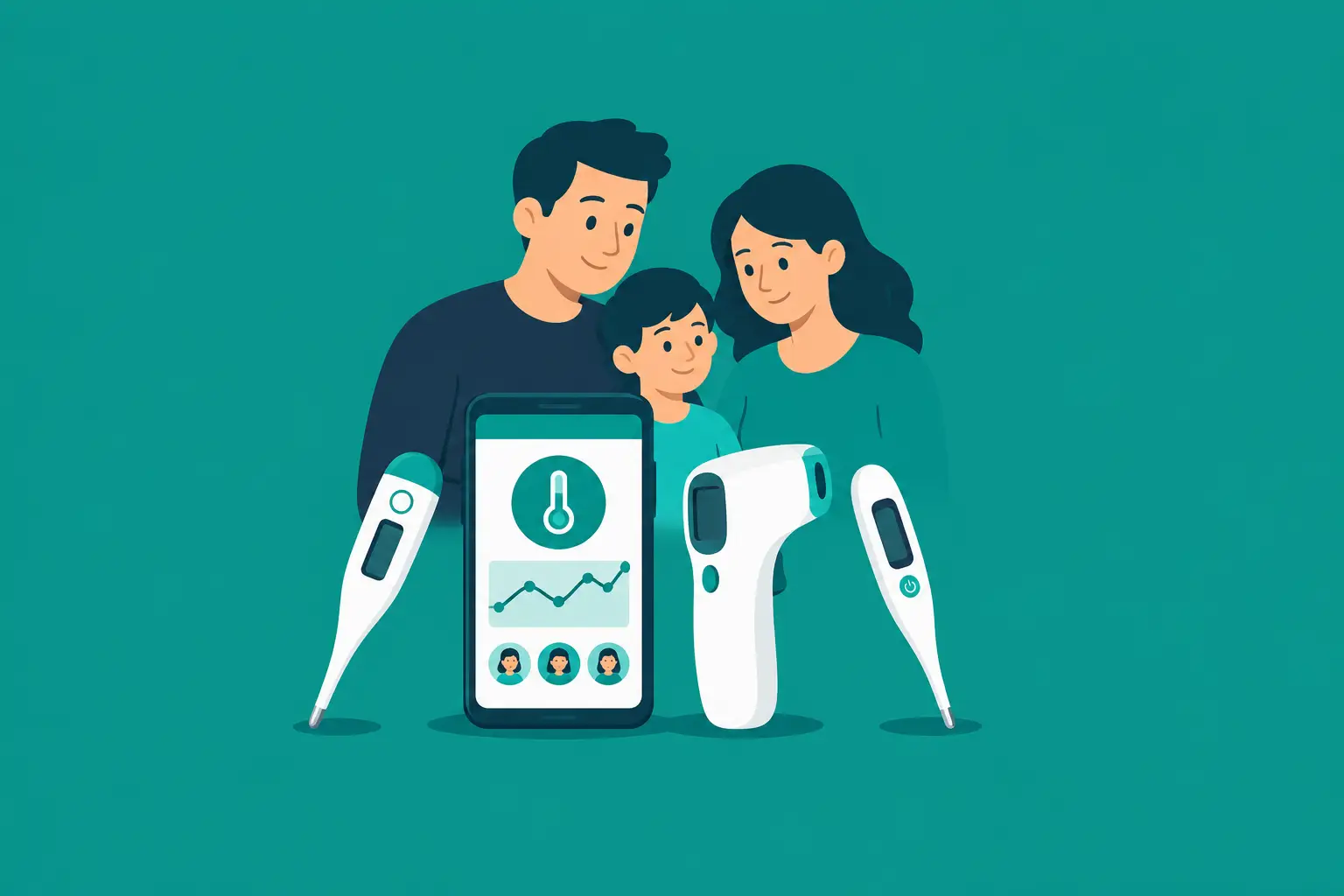
A fever can turn an ordinary evening into a handoff between parents, grandparents, and caregivers. In that moment, a temperature tracker comparison is less about finding the most technical tool and more about preserving a clear record: whose reading it was, when it was taken, what else was happening, and whether everyone involved can see the same information.
For a household, the right tracker should reduce the need to reconstruct the day from memory. It should make room for the reality of family care: multiple people, interrupted sleep, changing shifts, and more than one health task to manage at once.
What a family temperature tracker needs to do
A temperature reading only becomes useful household information when it has context. A bare number in a text message or a note on the counter can quickly lose its meaning. Was it for the child who stayed home from school, an aging parent, or a spouse? Was it logged before or after a nap? Did another caregiver already record a later reading?
The most useful tools answer those organizational questions without making caregivers do extra work. They should keep each family member's entries separate, place readings in a clear timeline, and make it easy to add the details that matter to your household. During a short illness, that can mean a simple sequence of readings. During a longer stretch of care, it may mean keeping temperatures alongside symptoms, routines, notes, and medication timing in one trusted place.
That distinction matters because a single-person tracking tool and a family coordination tool are not the same thing. One may capture data well, while the other helps a household act as one organized team.
Temperature tracker comparison: the main options
There is no universal winner. The best fit depends on how many people are involved, how often you need to record readings, and whether tracking is a one-time need or part of a broader family care routine.
Paper logs and notebook notes
A paper log is familiar, fast, and available even when a phone is charging in another room. For a single caregiver watching one person over a brief period, writing down a time and reading can be enough. Some families also prefer the physical visibility of a notepad on the kitchen counter.
The trade-off is coordination. A paper record stays where it was left, cannot alert another caregiver, and is easy to misplace during a busy day. It also becomes harder to scan when multiple people are recording information or when the notes need to be matched with other household care tasks. Paper works best as a simple backup, not as a shared family record.
Basic notes apps and spreadsheets
Notes apps and spreadsheets offer more flexibility than paper. Caregivers can create a table, add timestamps, and include comments. A shared document can give more than one person access, which is a meaningful step up from a notebook.
But flexibility can create its own burden. Someone has to build the format, remember the naming conventions, and keep entries consistent. A rushed caregiver may type a reading without identifying the family member, or add a note in a different place than everyone else. These tools also do not naturally connect temperature history with recurring routines or medication timers.
They can be a reasonable choice for families who like organizing their own systems and have straightforward needs. For households already juggling several care responsibilities, however, a blank spreadsheet often becomes another task to maintain.
Standalone temperature and symptom apps
Dedicated tracking apps are designed to record readings quickly. Many offer charts, history views, and space for symptoms or notes. This can be helpful when a caregiver wants a more structured record than a generic notes app provides.
The key question is whether the app supports the way your family actually shares care. Some are built around one user and one device. Others may allow a record to be exported but do not provide active, ongoing visibility for another caregiver. Before relying on one, check whether profiles are separate, whether entries can be edited clearly, and whether authorized family members can see updates without passing a phone back and forth.
A strong standalone tracker can be a good fit for a focused tracking need. Its limitation appears when illness management overlaps with the rest of family care, such as scheduled routines, as-needed medication timing, and communication between caregivers.
Wearables and connected devices
Wearables and connected devices appeal to families who want automatic or frequent data capture. Depending on the device, they may display trends and reduce the number of manual entries required. For some households, that convenience is valuable, particularly when a person is resting and caregivers are trying to keep a consistent record.
Automation is not the same as organization. A connected device may collect readings but still leave families with questions about access, household profiles, privacy, and how the data fits with other care information. Devices also introduce practical considerations: battery life, connectivity, account setup, device placement, and whether the information is visible to the right people at the right time.
These tools can be useful when their workflow fits your family. They are not automatically the best choice simply because they are more technical. A manually entered record that every caregiver can understand may be more useful than data that remains locked in one person's device account.
Family health coordination platforms
Family-focused platforms are built for the coordination problem, not just the temperature entry itself. The goal is to give a household one place for each person's health information, so caregivers can log readings, follow timelines, and stay aligned without piecing together messages, notes, and separate apps.
This format is especially helpful when care is shared. One caregiver can record a temperature while another checks the illness timeline, handles a routine task, or reviews what has already been logged. Separate family profiles reduce the risk of confusing one person's information with another's. Privacy controls also matter here: health information should be shared with the people involved in care, not monetized through advertising or sold as data.
Medication Timer fits this category by bringing temperature logs, illness tracking sessions, medication timing, and household sharing into one family-centered system. For caregivers, the advantage is not simply storing more information. It is having less to remember and fewer places to check when the household is under pressure.
How to choose without overcomplicating care
Start with the handoff test. If one caregiver records a reading and another person takes over later, can the second caregiver immediately understand the record? They should be able to see the family member, time, reading, and relevant notes without searching through texts or asking for clarification.
Next, consider whether the tool separates people cleanly. This is essential in homes with children, older relatives, or more than one person who may be unwell at the same time. A shared household view is helpful, but each person's history should remain distinct and easy to recognize.
Then look at the complete workflow. If your family is already using reminders, timers, symptom notes, or recurring health routines, a separate temperature tool can create fragmentation. A centralized platform may reduce duplicate entries and make everyday care easier to manage. On the other hand, if you only need an occasional one-person record, a simpler option may be perfectly adequate.
Finally, assess privacy and access. Ask who can see the information, whether access can be shared intentionally with caregivers, and whether the company explains how health data is handled. Convenience should not require giving up control of a family's personal information.
The feature checklist that matters during a busy week
A good comparison goes beyond charts and colors. Look for clear individual profiles, automatic timestamps, an easy-to-read history, and room for short notes. Shared caregiver access is valuable when more than one adult is responsible for the same person. Illness-specific tracking can also keep a temporary health event organized without mixing it into unrelated household notes.
Notifications and reminders can be useful, but only when they support your routine rather than create noise. The same is true for charts. A visual trend may help caregivers scan a record quickly, but it should never make simple entries harder to find. The best design is calm: quick to update at midnight, clear enough for someone else to understand at 7 a.m.
A temperature tracker should earn its place in your family's routine by making care feel more coordinated. Choose the option that helps every caregiver see the same story, keep each person’s information straight, and spend less time searching for details when your family needs calm, organized support.