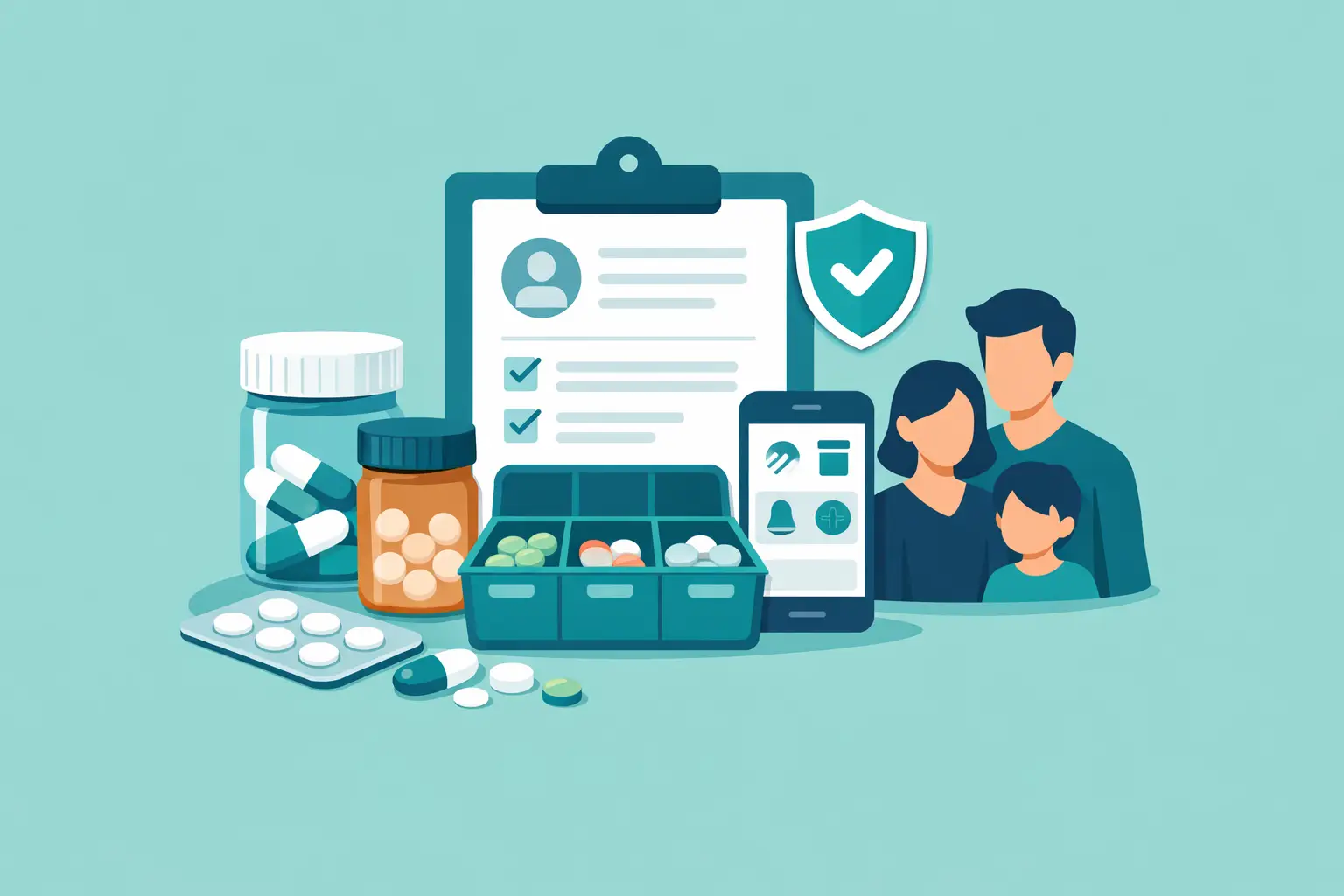
A prescription bottle on the kitchen counter can look simple until three people in the household have routines, a child is home sick, and one caregiver leaves for work before another arrives. The challenge in how to organize family prescriptions is not just keeping bottles together. It is making sure the right information is easy to find, the household stays coordinated, and no one has to rely on memory during a stressful moment.
A dependable system gives every caregiver the same clear picture. It creates one trusted place for schedules, records, refill details, and household handoffs - without turning family care into a complicated project.
Start with a complete household prescription inventory
Before setting reminders or sorting cabinets, gather what is currently in use for every family member. Include prescriptions that are taken on a routine schedule as well as those kept for occasional use. The goal is visibility: no forgotten bottle in a backpack, bathroom drawer, or travel bag.
For each prescription, record the information exactly as it appears on the current pharmacy label. This may include the family member’s name, prescription name, strength, instructions, pharmacy details, prescriber information, refill status, expiration date, and where it is stored. A clear photo of the label can be useful as a backup reference, especially when a caregiver is away from home.
Keep records separated by person from the beginning. Two family members may have similar-looking containers, similar names, or routines that happen at the same time. A household system should make it immediately obvious whose prescription is whose. Color labels, individual bins, or separate profiles in a family care app can all help, as long as the method is consistent.
This inventory is a recordkeeping tool, not a place to interpret instructions. When something on a label is unclear, write down the question and use the appropriate professional contact listed for the prescription rather than making an assumption.
How to organize family prescriptions in one place
Paper notes can work for a single person with a simple routine. They become harder to trust when multiple adults share care, children have changing school schedules, or an older relative needs support. The most reliable approach is to create one central source of truth that the people responsible for care can access.
That central place can be a dedicated family health organizer, a carefully maintained household binder, or a combination of a digital record and physical storage. What matters is that everyone knows where the current information lives. Avoid building parallel systems where one caregiver uses a phone note, another uses a calendar, and a third checks labels at the cabinet. Those systems can drift apart quickly.
A strong central record should answer a few practical questions at a glance: Who is this for? What is the current schedule? When was the most recent dose logged? Who gave or confirmed it? Is there a refill task coming up? If the answer requires searching through text messages, the system is carrying too much risk.
Medication Timer is designed around this household reality, allowing families to keep medication routines, safety timers, health readings, and caregiver updates in one shared, privacy-conscious place. The benefit is not more data for its own sake. It is a calmer handoff when more than one person is caring for the same family member.
Build routines around real family life
The best organization method is one your household can keep using on ordinary Tuesdays, not only when someone is sick. Start by mapping routines to the moments your family already recognizes, such as before school, after a regular meal, bedtime, or the start of a caregiver’s shift. Use the exact label instructions as the source for the schedule details.
Then decide how each routine will be confirmed. A reminder alone is not the same as a record. Reminders prompt action; a log tells the next caregiver whether a task was completed. In busy homes, that distinction matters. If a reminder sounds while one parent is driving and another is putting a toddler to bed, a shared completion record can prevent uncertainty later.
For prescriptions used only when needed, timing is especially easy to lose track of during illness. A safety timer and timestamped log can help caregivers see when the last dose was recorded without depending on a tired person’s recollection. Keep the tracker focused on facts: the time, the person, and the caregiver who logged it.
There is a trade-off between too many alerts and too few. A notification for every minor task can lead people to dismiss notifications altogether. Begin with the routines where missing a handoff is most likely, then adjust the reminder plan so it supports attention rather than competing for it.
Make storage clear, secure, and easy to audit
Digital organization works best alongside thoughtful physical organization. Choose a consistent storage location that is appropriate for your household and follow the storage directions on each label. The location should be known to caregivers but not casually accessible to children, guests, or anyone who should not handle the prescriptions.
Avoid combining different prescriptions in a single container or removing them from their original labeled packaging. Original containers preserve the identifying details your household needs when checking records, preparing for travel, or speaking with a pharmacy.
A simple physical setup may include a designated, secured household area with separate labeled sections for each person. Do not organize solely by bottle color or cap shape. Those details can change between refills. Names and current labels are more dependable.
Set a brief recurring check-in, perhaps once a month or when a refill arrives. Review the storage area, remove items that are no longer current according to your household’s disposal process, and update your record when labels or routines change. This is also a useful time to confirm that the digital list matches what is actually on hand.
Create better handoffs between caregivers
Most family prescription confusion happens at the handoff: one adult leaves, another comes home, a grandparent covers an afternoon, or a co-parent is handling the weekend. A good system does not require a long explanation every time. It gives the incoming caregiver a short, current view of what matters.
Use a consistent handoff note that identifies the family member, the most recently logged item, the next scheduled reminder, and any practical follow-up such as a refill pickup or a label question that still needs attention. Keep messages factual and avoid relying on vague phrases such as “I think it was handled” or “probably later.”
Shared access should also be intentional. Give caregivers the access they need, and review it when household responsibilities change. Privacy is part of safety. A family health record contains sensitive information, so choose tools and processes that treat it with care, avoid advertising-driven data practices, and make it clear who can view or update records.
Plan for school, travel, and illness days
A routine that works at home can break down quickly outside it. Before travel, school events, sleepovers, or a caregiver change, check that the needed original containers, current records, and caregiver contact details are ready. Keep the preparation process simple enough that it can happen before a rushed departure.
Illness days deserve their own organization plan because the household pace changes. Alongside prescription records, some families find it useful to keep a time-stamped illness session for temperature readings, symptoms, hydration notes, and caregiver observations. This creates a cleaner timeline than scattered texts and helps everyone caring for the same person work from the same record.
Do not try to document every detail perfectly. The purpose is to reduce guesswork, not create extra work for an already tired caregiver. A few consistent entries are more valuable than a complicated tracker that no one can maintain.
Know when your system needs an update
Your organization system should change when family life changes. A new prescription, a new caregiver, a move, a child becoming more independent, or an adult relative joining the household can all create gaps in an old setup. Review the system after these transitions instead of waiting for confusion to reveal the problem.
Watch for warning signs: duplicate reminders, conflicting notes, empty containers discovered unexpectedly, or caregivers asking the same question repeatedly. These do not mean your family has failed at organization. They simply show that the system needs fewer moving parts or a clearer shared record.
Family prescription organization is ultimately an act of care coordination. When every dose, every family member, and every handoff has one trusted place, the household gains something valuable: more confidence in routine moments and more calm when illness interrupts the day.