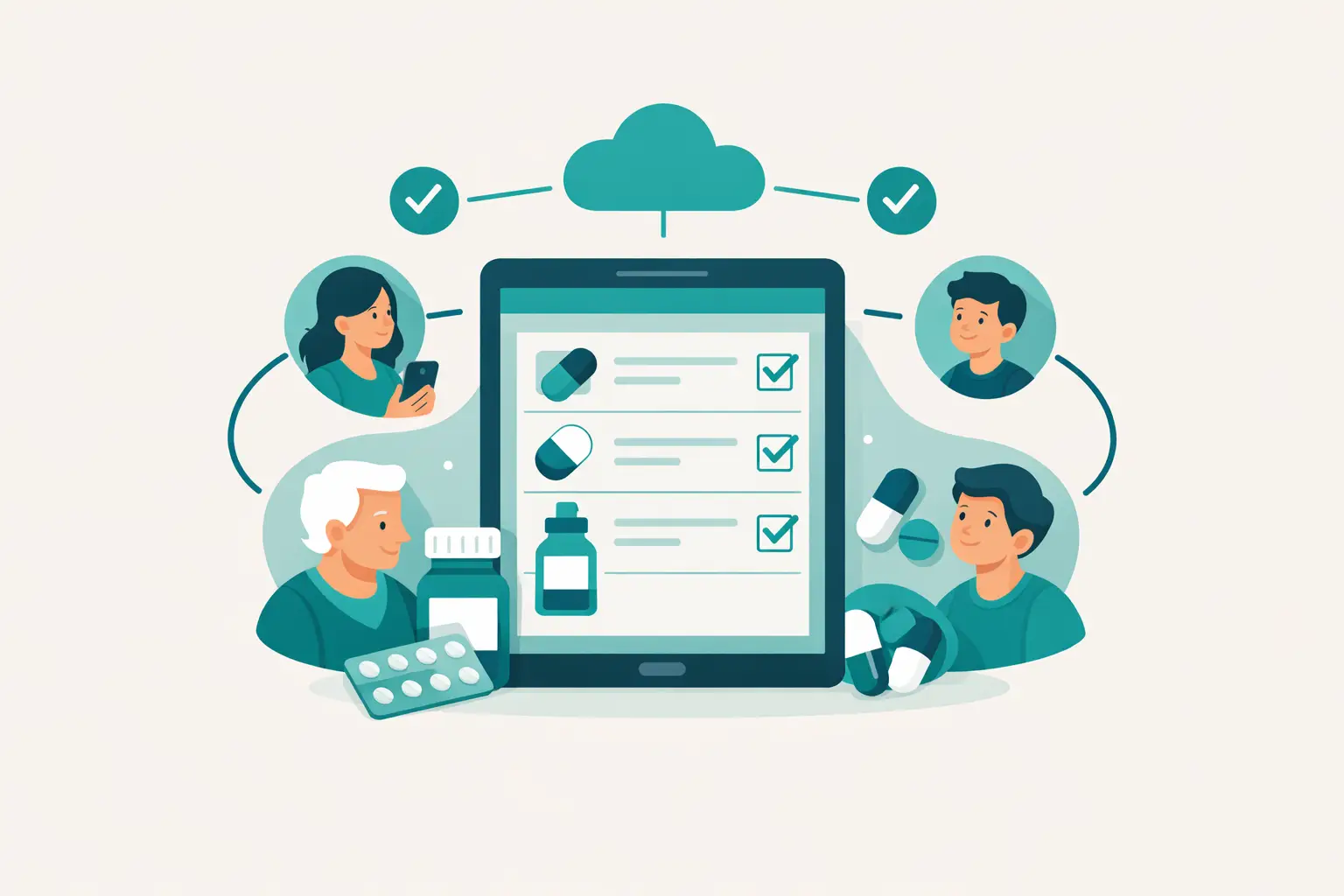
At 2:13 a.m., the question is rarely complicated: Was the dose already given, and by whom? But when a child is sick, a relative needs daily support, or caregivers are trading shifts, finding a reliable answer can feel harder than it should. A shared medication log for families gives everyone one clear record to check before they act, reducing guesswork when the household is tired, busy, or under stress.
The goal is not to turn family care into a clinical project. It is to create a calm, trusted place for the details that are easy to lose in text messages, sticky notes, and memory: completed doses, upcoming routines, health readings, symptoms, and caregiver updates. Every dose, every family member, one trusted place.
Why household medication tracking breaks down
Most families do not begin with a system problem. They begin with a practical need: one person is handling breakfast, another is doing school pickup, and someone else is checking in from another home. A quick verbal update may work once. It becomes less reliable when routines repeat, multiple people need support, or an illness lasts several days.
A kitchen calendar can show a schedule, but it cannot always tell a caregiver whether an item was completed moments ago. A group text creates a trail of updates, but the key detail may be buried beneath unrelated messages. Paper logs are familiar and private, yet they only help the people who can see the paper.
The issue is not that families are careless. It is that care coordination asks people to remember information at exactly the moments when they have the least available attention. A shared record reduces that mental load by making the current status visible to the people who need it.
What a shared medication log for families should show
A useful family log is more than a list of medication names. It should reflect how care actually happens at home: across different people, changing schedules, and occasional illness-related disruptions.
For each family member, the record should make it easy to see routines, completed entries, and the next planned action at a glance. It should preserve a clear time-stamped history so caregivers can understand what happened without reconstructing the day from memory.
Health readings and notes belong in the same household view when they are part of a family’s tracking routine. During a fever or other short-term illness, for example, a separate tracking session can keep readings, symptoms, completed entries, and observations together. That context matters. A number without a time, or a note without a clear household record, often creates more questions than confidence.
The strongest systems also distinguish between recurring routines and as-needed items. Recurring routines benefit from reminders and a predictable checklist. As-needed entries call for a clear completion record and safety timing visibility, so the next caregiver is not left estimating based on a vague message like, “I think I handled that earlier.”
Set up the log around your household, not a generic template
A shared log should make life simpler from the first week. Start with the family members who need active tracking, then add only the details your household will genuinely use. A system filled with unused fields can become another task to maintain.
Give every person a separate profile
Separate profiles prevent one family member’s schedule or health information from blending into another’s. This is especially useful in households with children, aging parents, or more than one person following a regular routine.
Use recognizable names and keep each profile focused. The person opening the log should be able to answer a basic question in seconds: Whose record am I viewing, what is due, and what has already been logged?
Create routines that match real life
Household schedules are rarely identical every day. A routine may need to account for school mornings, workdays, weekends, travel, or handoffs between homes. Build reminders around the moments when care is most likely to happen, rather than an idealized schedule that no one can maintain.
This is where a digital family tool can be more practical than a static spreadsheet. Medication Timer, for example, is designed to organize recurring routines, as-needed safety timers, and household health tracking in one family-centered space.
Decide who can update the record
Sharing works best when caregivers understand their role. One person may set up routines, while others log completion or add a reading during a busy day. The important part is that updates are made in the same record, not copied across separate notes and conversations.
Before relying on the log during a stressful week, agree on a few household conventions. Decide whether caregivers should add a short note when plans change, whether everyone needs notifications, and how you will handle a handoff when one person takes over. Small agreements make the system easier to trust.
Make handoffs clear when care changes hands
A shared log earns its place during transitions. One caregiver may leave for work while another arrives. A parent may be traveling while a grandparent helps at home. A partner may be asleep while the other manages an overnight illness check.
In those moments, the record should answer the questions that otherwise become texts: What was completed? What is next? Is there anything unusual to know? A quick note tied to the right family member is more useful than a long conversation that disappears in a message thread.
Keep updates factual and brief. “Logged at 7:00 p.m.” or “Reading added after school” provides useful context without forcing caregivers to interpret a page of notes. The log is a coordination tool, not a diary.
Consistency matters more than perfect detail. If caregivers reliably record the essential actions, the household has a dependable baseline. Extra notes can be added when they truly help the next person understand the situation.
Use a focused view when illness interrupts the routine
When illness strikes, normal household organization can unravel quickly. A family may need to track changing readings, symptoms, rest, hydration notes, or completed medication entries while also managing work, school absences, and sleep disruption. Switching among several apps and paper notes adds friction at the exact wrong time.
An illness-specific tracking session helps keep that period contained. Rather than scattering updates across permanent routines, a caregiver can review the relevant timeline in one place. This makes it easier to share accurate context across caregivers without searching through unrelated household records.
There is a trade-off: detailed tracking takes a little more effort in the moment. For a brief, uncomplicated day, a simple completion record may be enough. During a longer or more active illness period, a focused timeline can provide far more peace of mind. The right level of tracking depends on what your family needs to coordinate.
Protect the information your family shares
Family health organization involves personal information, even when the entries are simple. That is why privacy should be part of the decision, not an afterthought. A tool built for household care should make sharing intentional, keep the experience free from distracting ads, and treat family information with care.
Consider who truly needs access. A trusted caregiver may need to see current routines and recent updates, while another family member may only need a verbal check-in. Not every household needs the same sharing arrangement, and permissions should reflect real caregiving responsibilities.
Privacy also supports better communication. When caregivers know there is one appropriate place for health-related updates, they are less likely to scatter sensitive details across text threads, email inboxes, and handwritten notes left in public areas of the home.
Build a habit that holds up on busy days
The best shared medication log is the one your family can still use when everyone is rushed. Keep the process simple: check the record before taking responsibility for a task, log completion right away, and review the upcoming routine during caregiver handoffs.
If the household falls behind for a day, do not let that derail the system. Restart with the current information instead of trying to recreate every missed detail from memory. The value comes from restoring a clear, shared view of care.
A well-run family log does not ask caregivers to carry every detail alone. It gives them a reliable place to look, a simple way to update others, and a little more confidence when the day is already asking a lot.