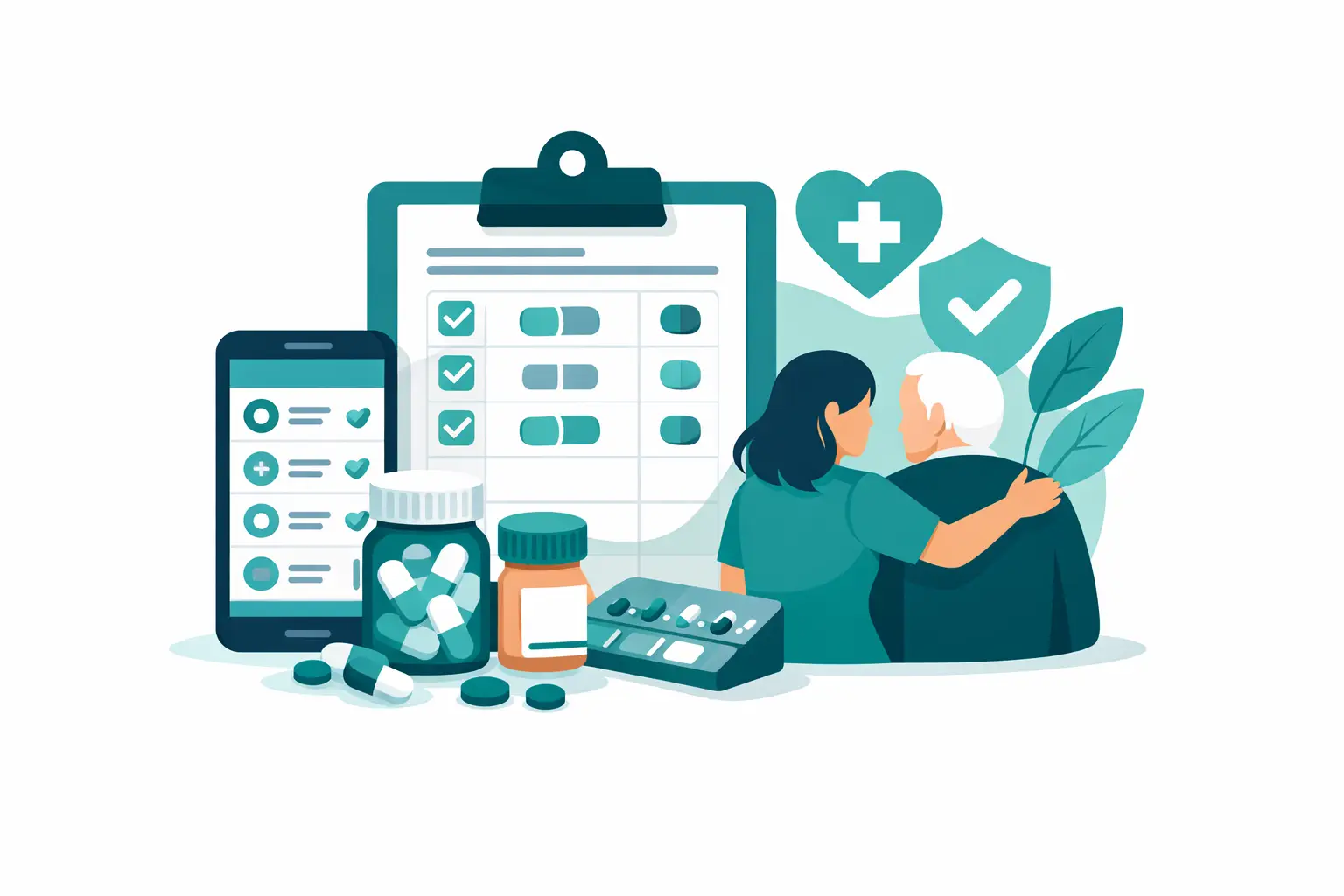
The hardest part of keeping a medication record is rarely writing down a name or a time. It is knowing whether someone else already handled it, finding the latest entry when a child is sick, or sorting out several family members’ routines without relying on memory. The best medication log templates make that information clear at a glance, so care stays coordinated when the household is busy.
A useful template is not necessarily the one with the most columns. For families, the right choice is the one that captures the details you need, is easy enough to use consistently, and can be seen by the people who share care. A paper sheet may work for one short-term situation. A digital log may be the better fit for ongoing routines, multiple caregivers, or more than one person in the household.
What the Best Medication Log Templates Include
A medication log should create a dependable record, not another complicated task. At a minimum, it needs a clear space for the family member’s name, the medication or item being tracked, the date, the time, and who recorded the entry. These basics answer the question that matters most during a hectic day: what has already been logged?
The best templates also leave room for the information that helps caregivers understand the record later. That may include the routine or reason for tracking, notes, the next scheduled time, and a simple status such as given, skipped, or needs follow-up. Keep notes factual and brief. A log works best when it preserves the details without becoming a diary.
For shared households, separate each person’s records. Combining a parent’s, child’s, and older relative’s entries on the same undivided page invites confusion. Use distinct pages, tabs, or profiles, and make the person’s name prominent on every record.
1. The Daily Medication Schedule Template
A daily schedule is the simplest and most familiar option. It lays out routine entries by time of day or by scheduled time, with a checkbox or initials field beside each one. This format is a strong choice for a stable routine that one or two people manage.
Its main strength is speed. A caregiver can scan the page and see where the day stands. Its limitation is that paper checkmarks do not notify anyone else, and an incomplete entry can be hard to interpret. If two caregivers are taking turns, add a column for initials and the exact time recorded. That small detail can prevent a great deal of uncertainty.
2. The As-Needed Dose Log Template
As-needed records need a different structure because the timing is not always fixed. Instead of a row for every hour, use one row per entry with the date, exact time, item, caregiver initials, and a notes field. A dedicated next-eligible-time field can also make the page easier to read when someone is checking the record quickly.
This template is especially useful during a short illness period or when care shifts between adults. It should be used to record what happened, not to determine what should happen next. Families should rely on the directions provided with their medication and their established care guidance for any decisions.
3. The Weekly Family Medication Log
A weekly grid gives a broader view than a daily page. Put days across the top and routine times down the side, then use a separate section for each family member. It can reveal gaps in household routines and reduce the need to recreate a new sheet every morning.
This format works well when the routine is predictable and the family wants a refrigerator-friendly reference. The trade-off is detail. If a day becomes unusual, a small square may not provide enough space for timing, caregiver names, or notes. Many families pair the weekly grid with a separate event log for exceptions.
4. The Illness and Medication Tracking Template
When illness strikes, a medication record often needs to sit alongside other household observations. An illness tracking template can keep dates, medication entries, temperature or other readings, symptoms, hydration notes, and caregiver observations in one chronological record.
The benefit is context. Rather than searching through text messages, sticky notes, and separate pages, caregivers can see what was recorded over the course of a day. This is also helpful when one adult needs to hand off care to another. Keep the layout simple: one timeline, clear timestamps, and enough room for factual notes.
Avoid trying to turn this type of template into a clinical chart. It is a family organization tool. The goal is a clear household record that supports communication and reduces repeated questions.
5. The Caregiver Handoff Template
A handoff template is built for the moments when responsibility changes hands: one parent leaves for work, a grandparent steps in, or partners divide overnight care. Along with recent log entries, it includes a short “what to know now” section, upcoming routine items, supplies to check, and the name of the person currently responsible.
This is one of the most practical templates for shared care because it addresses a common failure point: information staying in one person’s head. A concise handoff gives the next caregiver a starting point without requiring a long conversation or a search through messages.
How to Choose a Medication Log Template for Your Household
Start with the number of people and caregivers involved. A single-person daily checklist may be enough for one routine managed by one adult. A household with children, older relatives, rotating caregivers, or recurring illness tracking needs clearer separation and easier sharing.
Next, consider where the record must be available. A printable page can be convenient in one location, but it can be misplaced, left at home, or become outdated when another caregiver makes an entry elsewhere. A shared digital log is often better when people need to check the same live record from different places.
Then look at the level of detail you can realistically maintain. The most complete template is not useful if it feels too slow to fill out at 2 a.m. Choose fields that answer your household’s recurring questions. Usually, that means who, what, when, and who logged it. Add notes only when they serve a real purpose.
Privacy matters, too. A medication log contains personal household information. Whether you use paper or an app, decide who can access it, where it is stored, and how it will be kept away from casual viewers. Shared care should not require giving up control of family health information.
Paper Templates vs. Digital Medication Logs
Paper templates are affordable, visible, and easy to start. They can be especially helpful during a short-term situation, for a caregiver who prefers handwriting, or as a backup reference in a designated household spot. Their weakness is coordination. A page cannot alert another caregiver, track an updated record across locations, or protect against someone forgetting to initial an entry.
Digital medication logs offer a shared source of truth. They can organize separate family profiles, preserve timestamps, support recurring routines, and keep illness-related information in the same place. The trade-off is that everyone needs to learn the workflow and use it consistently. A digital tool should reduce steps, not create another system to maintain.
Medication Timer is designed around this family-centered need: every dose, every family member, one trusted place. It brings routines, as-needed safety timers, caregiver sharing, and health-reading logs together so the household is not managing care through scattered notes and messages.
Set Up a Log That People Will Actually Use
Before creating a new template, agree on a few simple household rules. Decide who records an entry, when it should be recorded, and how another caregiver will know the log has been updated. The answer may be “the person who handles it records it immediately,” but the rule should be explicit.
Use consistent names and labels. If one caregiver writes a full name while another uses a nickname or abbreviation, the record becomes harder to scan. The same applies to time format. Choose one format and keep it throughout the log.
Review the template after a few days. If you keep adding information in the margins, the layout is missing a useful field. If columns stay blank, remove them. The best medication log templates adapt to the household’s real routines instead of asking the household to adapt to an overly complicated form.
A clear log cannot remove every stressful moment, but it can replace uncertainty with a shared, dependable record. That is a meaningful kind of peace of mind when your family needs it most.