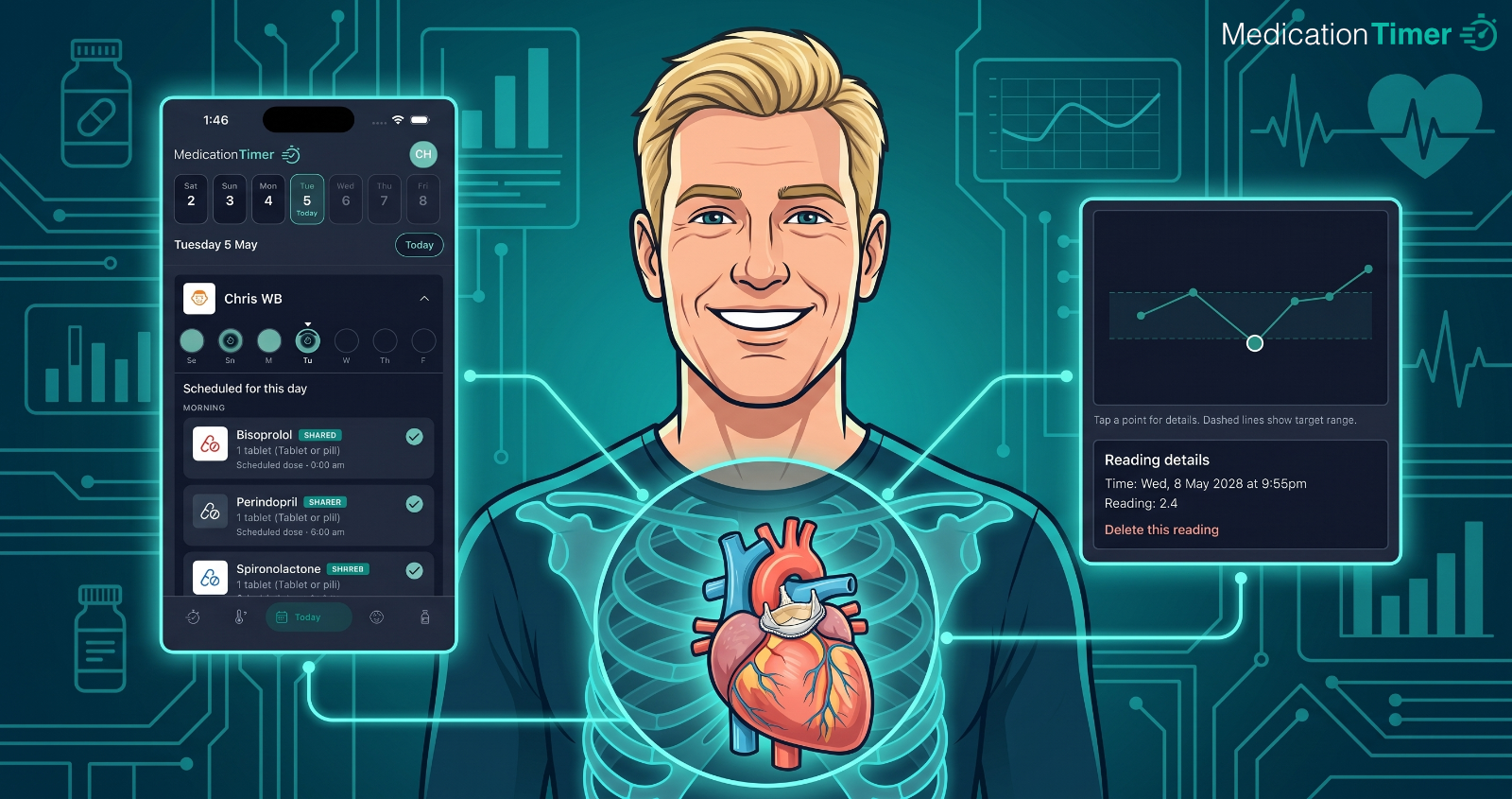
One year ago, my life changed quite suddenly.
It began with a sound: a slight, unusual murmur in my chest that I noticed during a quiet moment. I felt fine at the time. I wasn't short of breath, I didn't experience any of the classic warning signs of cardiovascular distress, and I considered myself a relatively fit person. I was even playing basketball twice a week. However, that quiet, rhythmic anomaly was enough to make me take it seriously.
I decided to get checked out, and that single choice likely saved my life.
Clinical tests revealed a congenital faulty aortic valve, a structural issue that affects about 1% of the population, often staying entirely dormant for decades before reaching a critical tipping point. In my case, the valve was actively failing. My heart was working dangerously hard to compensate, and it became clear that I needed open-heart surgery to avoid complete heart failure.
I underwent surgery at the Royal Adelaide Hospital to replace the valve with a mechanical one and repair the aortic root. While the surgery itself went incredibly well, waking up with a mechanical valve meant entering a permanent, high-stakes health routine.
Because a mechanical valve is a foreign object, the body’s natural response is to form clots on its carbon leaflets. To prevent a stroke, I now have to take Warfarin every single day, most probably, for the rest of my life.
The Razor-Thin Line of Warfarin Management
Warfarin is a powerful, unforgiving anticoagulant, and managing it requires absolute consistency. My blood must be kept at a highly specific thickness, measured by a reading called INR (International Normalized Ratio).
Too Low INR ⇢ Risk of Blood Clots & Stroke
Too High INR ⇢ Risk of Internal Bleeding
It is a narrow, volatile target range that requires constant clinical monitoring and daily vigilance. Before this, I had never had to manage complex medications or health readings. Like many, my experience was limited to "as-needed" medications when someone in the family caught a cold or a bout of "man flu."
It was the initial lack of tools for these specific workflows that inspired me to build Medication Timer in the first place. But as I settled into my new post-operative workflow, I realised that managing a life-altering health routine required more than just simple timers. It required a cohesive ecosystem.
Where Modern Health Tech Falls Short
The truth is that Apple Health and other native platforms are highly effective for managing basic, linear medications for a single individual. If you are a solo user taking a daily multivitamin or a standard blood pressure pill, the native tools are excellent.
But native platforms let you down in two major areas:
- High-Stakes Multi-Variable Tracking: They treat medications and vital health readings as separate, isolated silos. For someone on Warfarin, a dose is directly dependent on an INR reading. Separating them creates cognitive friction and risks.
- Family and Caregiver Coordination: They assume health is a solo journey. In reality, when you are recovering from major surgery or managing a chronic illness, health is collaborative. Your partner, parents, or co-caregivers need real-time, shared access to what has been taken, what is due, and what vitals have been recorded.
- Multi-Member Complexity (The Parallel Route Challenge): They assume a the only person with active medical needs is yourself. In reality, it is incredibly common for multiple family members to run completely independent, parallel health routines. For example, my son has asthma, which requires its own strict schedule of daily preventers, symptom-based relievers, and active monitoring. Trying to coordinate my complex cardiovascular recovery alongside his active asthma routine within a single, non-collaborative account structure is an exercise in operational chaos.
This realisation is what drove the rebuild and expansion of Medication Timer. I needed an app that didn't just remind me to take a pill, but one that could act as a trustworthy, collaborative daily hub for a family's collective health journey. It’s a platform that keeps our baseline routine organized, and then steps up to help even more when my son brings home a virus from school that hits us all at the same time; turning a chaotic household of overlapping fevers, staggered pain-relief schedules, and differing recovery needs into something we can navigate safely together.
Linking Personal Crisis to Product Features in v2.2.0
Every major feature in our massive v2.2.0 update is a direct response to the friction points I, and thousands of other families, faced while managing complex, shared care.
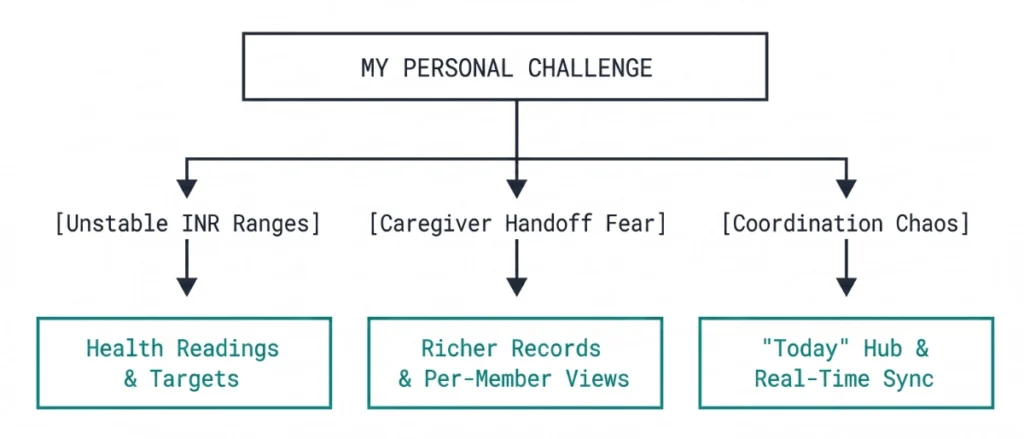
1. Unified Timelines: Introducing "Today" as the Daily Hub
When you are managing a condition, your week isn't just a list of pills. It is a sequence of events: taking medication, checking blood pressure, measuring blood glucose, or tracking INR in my case.
- The Inspiration: I found myself switching between different apps and physical paper logs to piece together my daily status. Did I take my Warfarin? What was my INR reading this morning?
- The Solution: I built the new Today screen to pull everything into a single, cohesive timeline. Scheduled doses and health reading expectations (like INR) sit side-by-side on the same visual calendar.
- The Impact: It completely eliminates the "did we already do this?" question. Parents managing a child’s asthma plan or partners tracking post-op vitals can see at a glance what is due, done, and coming next.
2. Guardrails Against High-Stakes Errors: Health Readings & Vitals
For a Warfarin patient, taking a double dose because of a tracking error is a potentially significant medical event.
- The Inspiration: I needed a system that actively helped me visualise whether my vitals were staying within safe margins. If my INR dipped below 2.5 or climbed above 3.5, I needed to see that and record it to better understand trends and potential impacts on my health management.
- The Solution: The app now features a robust Health Readings & Vitals tracker. You can log blood pressure, heart rate, blood glucose, INR and weight. Crucially, you can set custom target ranges for these readings.
- The Example: If your clinician sets your INR target range from 2.5 to 3.5, Medication Timer will flag readings as in-range or out-of-range at a glance.
3. Clearer Ownership: Per-Member Profiles & Richer Records
When health management is a family affair, blended lists of medications lead to dangerous confusion even with the best intentions. This can get even harder to manage with people dealing with medication routines in a co-parenting situation.
- The Inspiration: If a household is tracking a child’s asthma treatment alongside an adult’s daily heart medications, a shared, mixed list is a recipe for a dosing accident.
- The Solution: I completely restructured how schedules are organised. Everything is now built around Per-Member Configuration. When you toggle between family members, the entire layout, history, and target parameters shift to focus solely on that individual. We also added fields for strength, units, and custom instructions so that caregiver handoffs are entirely unambiguous.
4. Co-Caregiving in Real Time: Shared Coordination (Family Plan)
When I came home from the Royal Adelaide Hospital, I was physically limited and fatigued from the trauma of open-heart surgery. My partner had to step in and help coordinate my care.
- The Inspiration: If my partner logged that I took my morning dose, I needed to see that update instantly on my device without having to shout across the house or send a text message.
- The Solution: Under our newly introduced Family Plan, we built Real-Time Sync. When one caregiver logs a dose, a reading, or an update, it syncs across all linked devices in near real-time. It turns medication tracking from a stressful solo responsibility into a supportive, collaborative effort.
5. Closing the Feedback Loop: Family Reports for Clinician Alignment
Finding your safe "baseline" when starting a critical drug like Warfarin is an iterative, clinical balancing act. Your cardiologist and GP need to see exactly how your body responds to specific dosages over time.
- The Inspiration: During my early weeks of recovery, my Warfarin dose was constantly being adjusted based on my INR results (starting out daily and gradually expanding to a weekly or fortnightly process). If my INR was 1.8, they bumped up the dose; if it spiked to 3.8, they dialed it back. To do this safely, my doctor needed to see the exact relationship between my daily dose history and my logged INR values. Bringing scribbled notes, vague recollections, or disorganised screenshots to a high-stakes clinical appointment felt dangerous.
- The Solution: We introduced Family Reports to the Family Plan. This feature allows you to instantly generate exportable, chronological summaries of both medication compliance and recorded health vitals over any chosen period.
- The Impact: Instead of trying to reconstruct my compliance history under pressure, I can now hand my clinician a clean, comprehensive PDF or link to a report of my daily Warfarin intake paired with my INR values. It turns guesswork into a collaborative, data-driven medical decision.
Software with Heart
Medication Timer began as an elegant utility. But my experience on the operating table transformed my vision for the product.
When you are healthy, managing medications is an afterthought. When you or a loved one is vulnerable, it is a daily battle for stability. Out latest releases is my contribution to making that battle a little lighter, a little clearer, and much safer. It is built to ensure that no caregiver has to wonder if a dose was missed, and no patient has to navigate their high-stakes routine alone.
If you are interested to read about how I have setup Medication Timer to help manage my post-op routine I have written it up in the Warfarin management and daily medication routines for those dealing with post-operative heart surgery care page!