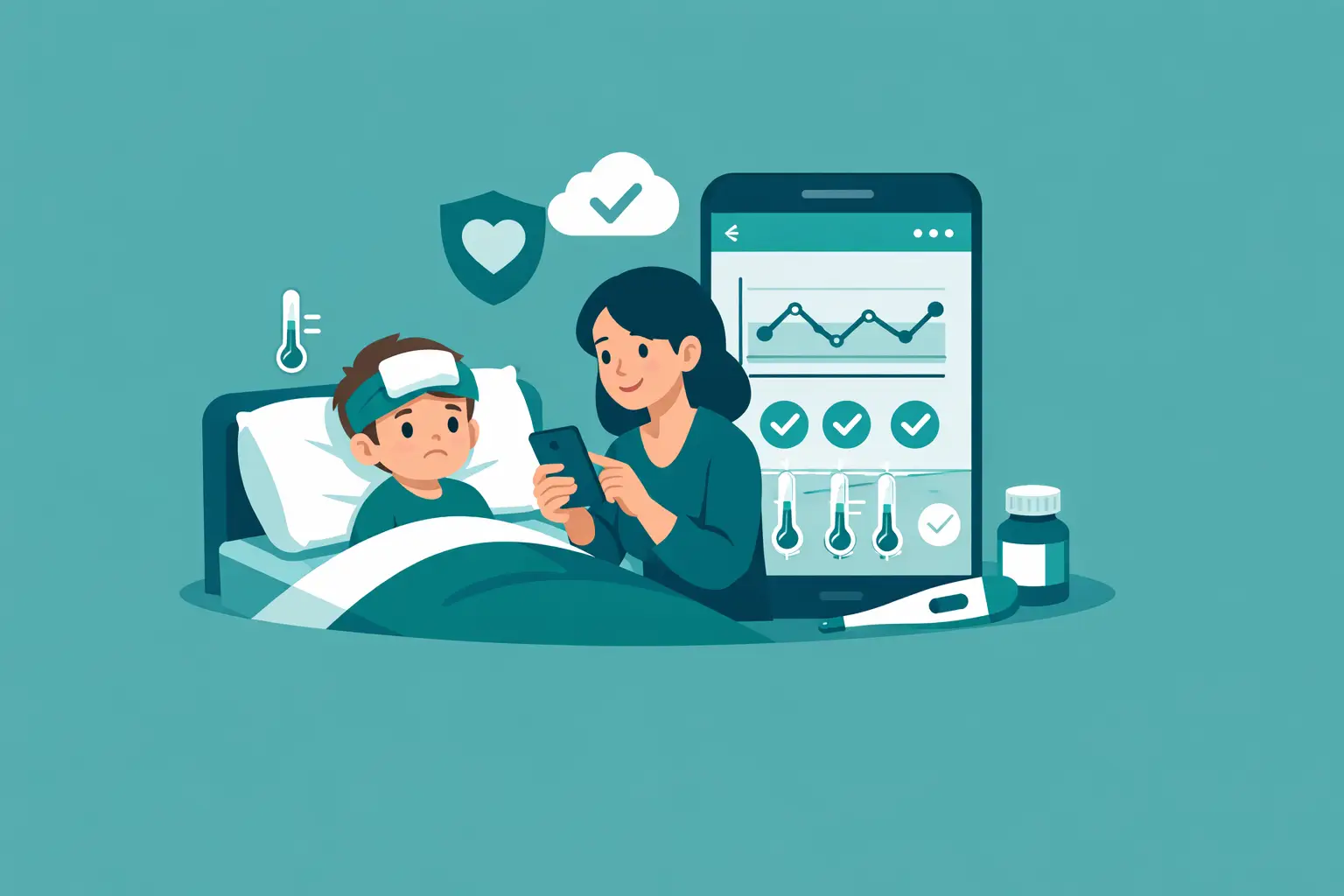
When a child is sick, the hard part is often not taking a temperature. It is remembering what the reading was, when it changed, who checked it, and what else was happening at the time. A temperature log app for kids gives your household one trusted place for those details, so care does not depend on a paper scrap, a fading text thread, or one exhausted caregiver's memory.
This is not about turning parents into clinicians or making a routine illness feel more complicated. It is about creating calm, accurate records when the day is already busy. A clear log helps families stay organized, coordinate care across adults, and preserve the context that is easy to lose when everyone is tired.
Why temperature tracking gets messy so quickly
A single temperature reading is simple. A full day of readings, symptoms, rest, meals, medications, handoffs, and interruptions is not. Parents may check a child before work, a grandparent may help in the afternoon, and another caregiver may take over overnight. Without one shared record, each person is left to reconstruct the story from memory.
Paper notes can work for a quiet afternoon, but they are easy to misplace and difficult to share. Text messages solve part of the communication problem, yet important details disappear inside unrelated conversations. Notes apps are better than nothing, but a general note rarely provides a consistent structure for time-stamped health information.
The result is unnecessary uncertainty. Did someone already record that reading? Was it from this morning or last night? Which child was it for? A dedicated log reduces those small points of confusion before they become stressful household conversations.
What a temperature log app for kids should do
The best tool is not the one with the most clinical-looking dashboard. It is the one your family can use accurately when attention is divided. For most households, that means a simple, fast workflow that puts each child's information in the right place.
Keep every reading tied to time and child
A useful entry captures the reading, the time, and the family member without extra steps. That basic structure creates a reliable timeline. Instead of recalling that a child "felt warm earlier," caregivers can see the sequence of recorded information in order.
Separate profiles matter even more in homes with siblings. During a household illness, details can blur together fast. Individual profiles keep one child's readings and notes from being confused with another's, while still allowing a parent to view the whole household from one account.
Leave room for context, not clutter
Temperature numbers tell only one part of the household story. A short note can preserve context such as whether a child was resting, at school, traveling, or having a difficult night. The goal is not to document every moment. It is to save the details your family may otherwise forget when reviewing the day.
Look for a format that makes notes optional and easy. If logging feels like paperwork, it will not hold up during a long night or a rushed morning. The strongest systems balance useful context with a low-effort routine.
Support shared caregiving in real time
Family care is often a relay. One adult may be at work, another may be home, and a relative or babysitter may step in. A shared log lets each authorized caregiver see the same current information instead of relying on repeated calls and messages.
This is especially helpful at handoff moments. The caregiver taking over does not need a verbal recap built from memory. They can open the record and understand what has been logged so far. That clarity protects everyone from duplicated work and missed information.
Bring related care routines together
Temperature tracking can become more useful when it sits beside the routines a family already manages, including illness notes, health readings, and medication schedules. Keeping these records together does not mean every entry must be complicated. It means caregivers do not have to search across several tools when they need a clear picture of the day.
Medication Timer is designed around this household view, with family profiles, shared care coordination, illness tracking sessions, and health-reading logs in one private place. For families managing more than one person or more than one routine, that central view can reduce the mental load significantly.
Build a log your family will actually maintain
Consistency matters more than a perfect system. Start by agreeing on where information belongs and who can add it. If your household uses an app, make it the default location instead of copying the same details into texts, notes, and paper lists.
Keep entries factual and brief. Record the reading and time, then add a note only when it helps explain the moment. A clean timeline is easier to review than a long stream of scattered observations.
It also helps to decide how updates will be handled. Rather than sending a message for every new entry, family members can use the shared log as the source of truth and reserve messages for coordination. This prevents a common problem: one adult has the newest information in a text thread while another is looking at an older note.
For households with recurring routines, a reminder can support the habit of checking the log and recording information at the right time. The reminder should reduce mental effort, not create pressure. If a family's schedule changes, the tracking method should be easy to adjust with it.
The privacy question families should ask
Health information is personal, even when it is a simple temperature reading. Before choosing an app, families should understand who can view their data, how caregiver access is managed, and whether the company uses health information for advertising or sale.
A family health tool should make sharing intentional. Parents and guardians need to be able to include the people who help with care while keeping access limited to the right circle. That is different from broadcasting updates through a group chat where personal details may remain long after the immediate need has passed.
Privacy also supports consistency. Caregivers are more likely to use a central system when they trust that it was built for family coordination rather than data collection. Clear permissions, no ads, and a straightforward privacy approach are practical features, not just fine print.
When a simple note may be enough, and when an app helps more
Not every situation requires a dedicated app. If one caregiver is home with one child for a short period, a paper note or a phone note may be perfectly adequate. The right system should match the complexity of your household, not add another obligation.
An app becomes more valuable when care extends across several adults, multiple children, changing schedules, or a longer illness period. It is also useful for families who already track recurring health routines and want fewer places to check. In those situations, the advantage is not the technology itself. It is the shared, time-stamped record that remains available when one person cannot remember every detail.
The trade-off is setup. Creating profiles and inviting caregivers takes a few minutes at the beginning. But that small investment can prevent repeated explanations later, especially when a child is home from school, an adult has to leave for work, or care moves between households.
Make the record work for your next handoff
The value of a temperature log is most visible when someone else needs to pick up where you left off. A calm, organized record lets a caregiver see the information that has already been captured without asking a sick child the same questions or waking a tired parent for a recap.
Choose a process simple enough to use on an ordinary weekday, not just during a stressful illness. Then, when illness strikes, your family already has one familiar place to record what happened, keep care coordinated, and make the next handoff a little easier.