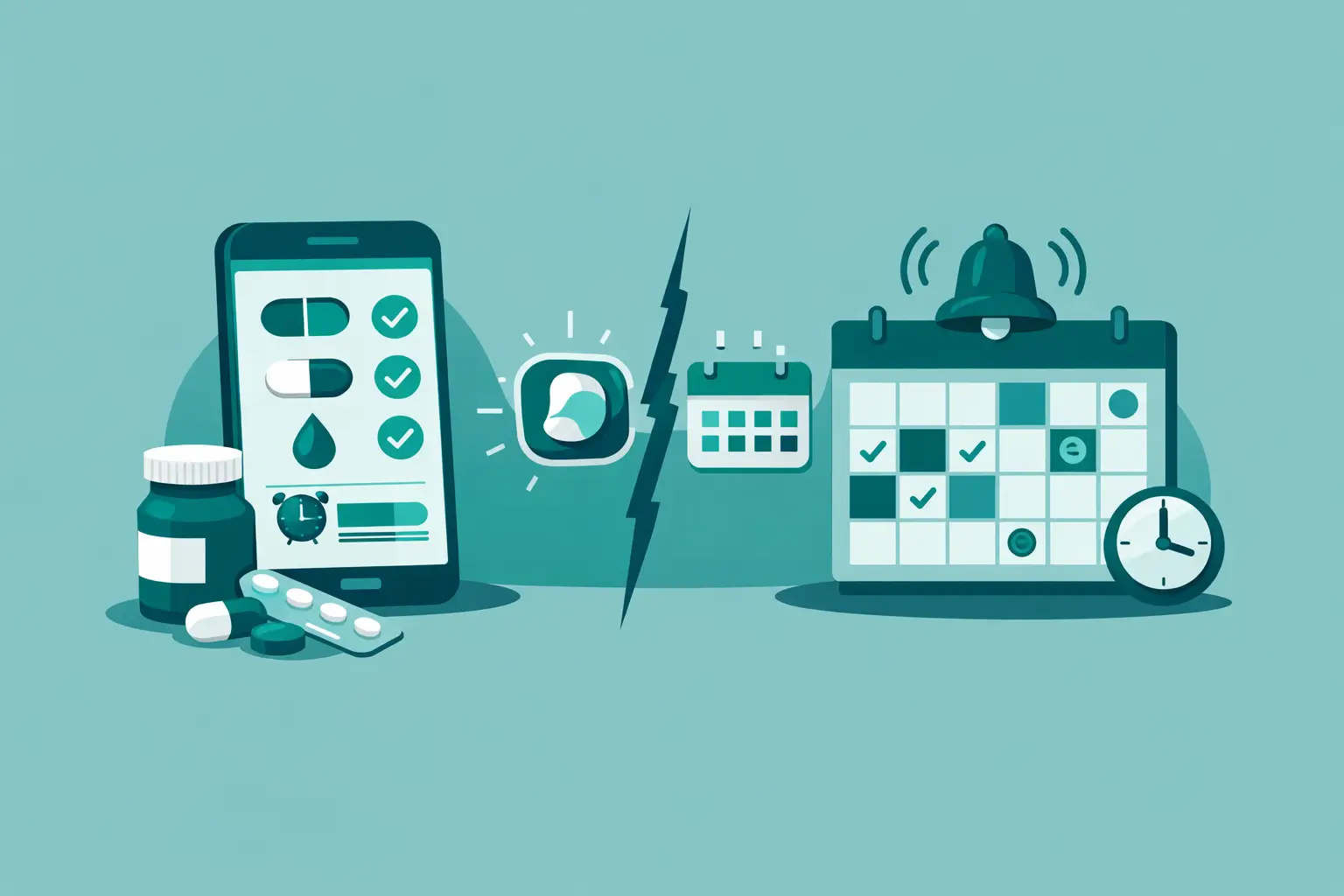
At 2:13 a.m., a calendar alert can tell you that something is due. It cannot always tell you whether another caregiver already handled it, which family member the alert was for, or what happened earlier in the day. That is the practical difference in a medicine tracker versus calendar reminders decision: one is built to prompt a task, while the other can help a household organize the full care record around that task.
For a single, predictable reminder, a phone calendar may be enough. For families coordinating recurring routines, temporary illness tracking, multiple people, and more than one caregiver, a purpose-built tracker often brings more clarity when it matters most. The right choice depends on the complexity of your household, not on whether one tool is universally better.
Medicine Tracker Versus Calendar Reminders: The Real Difference
Calendar apps are designed around time. You create an event, choose when it repeats, and receive a notification. This works well for appointments, school events, and simple personal routines. A reminder can be fast to set up because most people already have a calendar on their phone.
A medicine tracker is designed around care coordination. Time still matters, but the record is connected to the person, the item being tracked, the history of completed entries, and often the caregivers involved. Instead of seeing a generic alert called “Medicine,” you can see a structured routine associated with the right family member and a clear log of what has already been recorded.
That difference becomes more meaningful when the person receiving the alert is not the only person managing the household. A parent leaving for work, a grandparent helping after school, and a partner handling bedtime may all need the same current information. A shared calendar can send notices to several people, but it does not always create a simple, reliable answer to the question everyone is asking: “Has this been handled?”
Where calendar reminders work well
Calendar reminders are a sensible choice when the routine is straightforward and one person is responsible for it. They are familiar, quick, and useful for a reminder that does not require much context afterward. If you only need a prompt, not a history, a calendar keeps the process simple.
They can also work for household tasks surrounding care, such as picking up supplies or scheduling a follow-up conversation. These are time-based events, and a standard calendar handles them naturally.
The limitation is that a calendar event usually stays an event. Marking it complete may not provide a detailed, family-visible record. If an alert is dismissed accidentally, or if one caregiver assumes another took care of it, the calendar may not resolve the uncertainty.
Where a medicine tracker adds clarity
A dedicated tracker helps turn reminders into an organized household workflow. It can keep recurring schedules, one-time entries, and logged history in one place. That structure reduces the need to reconstruct the day from text messages, memory, or separate notes.
For example, during a busy week, a caregiver may need to track several routines across children, a spouse, or an older relative. The challenge is not simply remembering an alert. It is seeing the right person, the right routine, and the most recent record without sorting through a crowded personal calendar.
Medicine trackers can also support as-needed logging with safety timers that show elapsed time from a recorded entry. The value is operational clarity: caregivers can refer to a shared timestamp instead of relying on a rushed mental calculation or an old message thread. Any medication use should always follow the applicable label and guidance from a qualified health professional.
Shared Care Is the Point Where Calendars Often Fall Short
A calendar is usually owned by an individual account. Even when calendars are shared, access can be uneven. One person may receive notifications while another only sees the event if they remember to check. Updates may be missed, duplicated, or buried among work meetings and birthday reminders.
Family care needs a different kind of visibility. Caregivers need to know what is planned, what has been recorded, and what still needs attention, without turning the household group chat into a running health log. A tracker designed for families gives care information its own protected space.
This matters during ordinary routines, but it matters even more when illness strikes. A household may be tracking changing symptoms, temperatures, rest, fluids, or other health readings alongside medication routines. Those details are difficult to organize as a series of disconnected calendar events. They are easier to understand when they sit together in an illness-specific tracking session with dates, times, and family-member context.
That does not make a tracker a replacement for professional care or medical judgment. It gives families a clearer record to reference and share when they need to describe what has been happening.
The Hidden Cost of Using a Calendar for Everything
The biggest issue with calendar reminders is not that they fail. It is that they ask caregivers to create their own system around them.
Someone has to decide how to name each event consistently. Someone has to keep reminders separate for each family member. Someone has to update a recurring event when a routine changes. Someone has to communicate completion outside the calendar, especially when multiple adults are involved.
Those small tasks can be manageable on a calm day. During a difficult night, a school morning, or a week when more than one person in the house needs attention, they create extra mental work. The calendar becomes a collection of alerts rather than a trusted source of truth.
A family-focused platform such as Medication Timer is built around the idea that every dose, every family member, and every caregiver update should have one organized home. It can hold recurring routines, temporary tracking, health readings, and shared care activity without mixing them into the same place as meetings and errands.
Privacy is part of that decision, too. Health-related details deserve more care than a standard household reminder. Families may prefer a tool that is designed for this information, has no ads, and does not sell health data rather than relying on broad consumer tools meant for every type of event.
How to Choose the Right Tool for Your Household
Start with the question behind the reminder. If the answer is simply “I need a nudge at a certain time,” a calendar may be perfectly appropriate. If the answer includes “I need to know who recorded it,” “I need to see history,” or “other caregivers need the same information,” a medicine tracker is likely the stronger fit.
Consider these four signs that a dedicated tracker may reduce friction for your family:
- More than one person helps manage care.
- You track routines for more than one family member.
- You need a record of completed entries, not just an alert.
- Temporary illness periods require notes, readings, or symptom tracking alongside the usual routine.
There is no need to force every household task into one app. Many families use a calendar for appointments and logistics while using a tracker for the care details that require precision and shared visibility. That split can be easier than trying to make a general calendar do a specialized job.
Build a System People Can Use Under Stress
The best care organization system is not the one with the most notifications. It is the one a tired caregiver can understand in seconds. Names should be clear, records should be current, and every person who needs access should be able to see the same information without asking for a recap.
Set up the system before a stressful moment if possible. Add family members, establish the routines you want to track, and make sure caregivers know where to check the record. Keep calendar reminders for the events they handle well, and reserve a medicine tracker for the details where uncertainty could create confusion.
When care is shared, confidence comes from having one trusted place to look. A well-organized record cannot remove every difficult moment, but it can replace avoidable guesswork with a clearer next step for the people caring for your family.