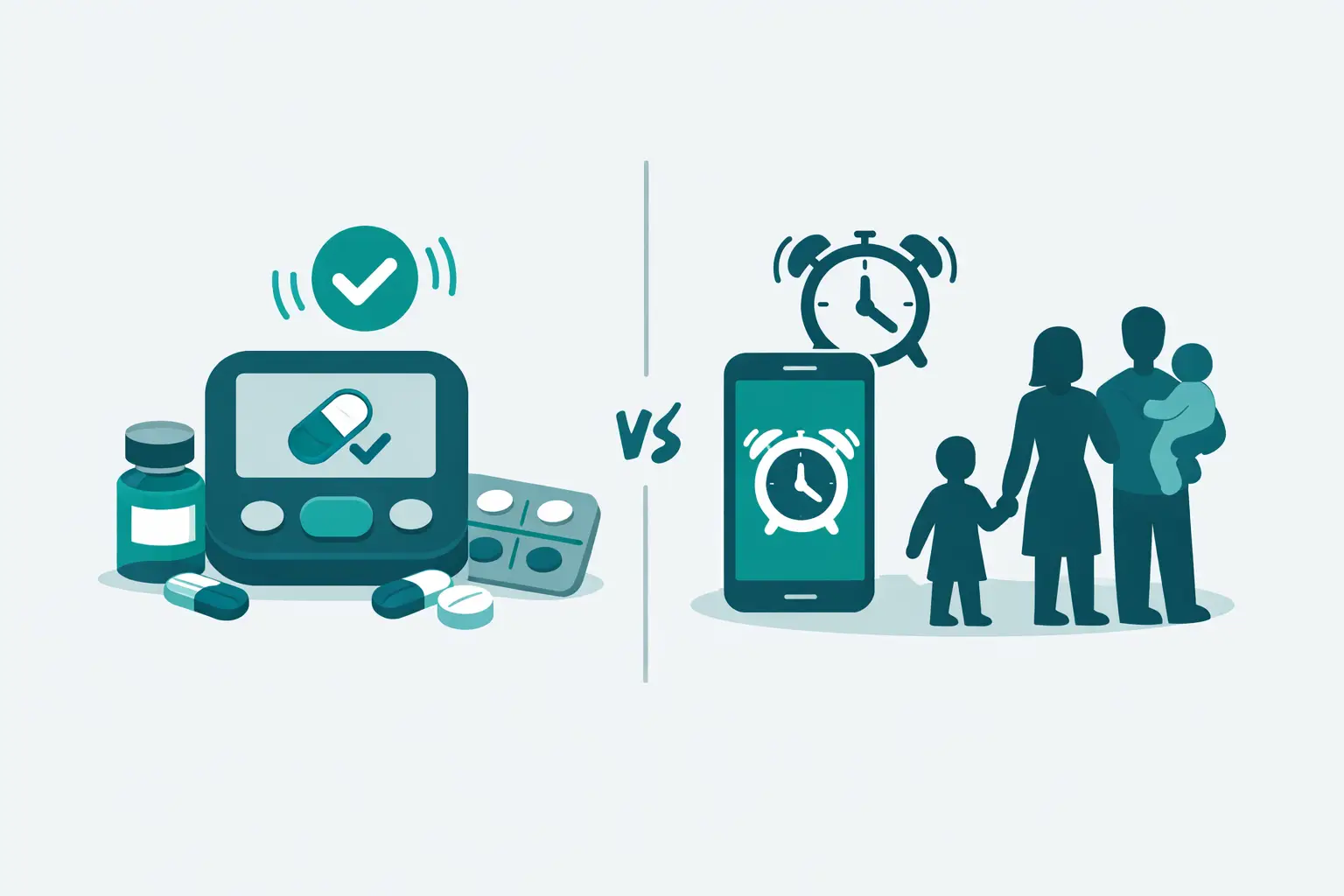
A phone alarm can be enough when one person has one simple routine. But family care rarely stays that simple for long. Between school mornings, work calls, bedtime, a sick child, an aging parent, and more than one caregiver, the real question behind medicine reminders versus phone alarms is not which one makes a sound. It is which one helps everyone know what has happened, what is next, and who is handling it.
Medicine reminders versus phone alarms: the real difference
Phone alarms are general-purpose alerts. They are fast to create, familiar, and already sitting in most people's pockets. You can label one, pick a time, and move on. For a single repeating task, that may be all a household needs.
Medicine reminders are built around the care task itself. Rather than only signaling that a time has arrived, a dedicated system can keep the routine, family member, timing history, and caregiver activity together. That distinction becomes meaningful when care is shared or when the household is managing more than one health-related routine.
An alarm answers, “What time is it?” A medication reminder system is designed to support the next questions: “Which family member is this for?” “Was it already handled?” “Who logged it?” “What needs attention later?”
Neither tool replaces a clinician, pharmacist, prescription label, or a family's own care instructions. The value is organizational: reducing the chance that important details get lost in a crowded day.
Where phone alarms work well
Phone alarms have a rightful place in family organization. They are useful when the routine is stable, the responsibility belongs to one person, and there is little need to document or share what occurred. They also work well as a quick backup for an appointment, a refill pickup, or a temporary household task.
Their strength is speed. There is no new system to learn, and most people already know how to set, snooze, dismiss, and rename an alert. For an adult independently managing a straightforward personal routine, that convenience can be hard to beat.
The trade-off is that an alarm has limited context. A label can say “medicine,” but it may not clearly distinguish among family members, track whether the alert was acted on, or show another caregiver what happened after it was dismissed. When several alerts look alike, the phone becomes a stream of notifications rather than a reliable household record.
A dismissed alarm is especially ambiguous. It may mean the task was completed, postponed, noticed by the wrong person, or cleared simply to stop the sound. In a busy home, those are very different outcomes.
Why reminders built for care change the picture
Dedicated medicine reminders help turn a recurring alert into a shared care workflow. The goal is not to make family health feel clinical. It is to give ordinary caregivers a calmer, clearer way to organize responsibilities that can otherwise live in text messages, sticky notes, memory, and multiple phones.
One household view reduces guesswork
A family-centered reminder system can separate routines by person. That matters when two children have different needs, a partner has a recurring schedule, or an older relative is receiving support at home. Instead of relying on an alarm label that may be too short or too vague, caregivers can see the routine in its proper context.
This structure also makes it easier to review the day without scrolling through old notifications. The question is no longer, “Did anyone see that alarm?” It becomes, “What does the shared record show?”
Shared caregiving needs visibility, not more messages
Many medication-management problems are actually communication problems. One parent is at school pickup. Another is working late. A grandparent is helping for the afternoon. Someone assumes someone else took care of the task, and no one wants to interrupt a busy day with repeated check-ins.
A phone alarm usually belongs to one device and one person. A shared reminder system is designed for active coordination. The right people can view the same plan and see logged activity in one trusted place. This can reduce duplicate work, uncertain handoffs, and the familiar flurry of “Was this done?” messages.
That visibility is valuable even when everyone is in the same house. During an illness, routines change quickly and mental bandwidth shrinks. Clear records offer reassurance without requiring anyone to rely on memory alone.
Timing tools can support safer routines
Some household care tasks are recurring. Others are occasional and need careful spacing or documentation. A standard phone alarm can alert at a chosen time, but it is not inherently designed to connect the alert with a history of related activity.
Purpose-built tools may include safety timers for as-needed routines, scheduling views, and logs that keep each event attached to the appropriate family member. These features do not tell a family what care decisions to make. They help the family carry out and communicate the plan they already have.
The difference may seem small on an ordinary Tuesday. It feels much larger at 2 a.m., when a caregiver is tired, another adult is trying to help, and everyone needs a dependable record rather than a best guess.
The hidden cost of alarm overload
Most phones are busy by design. Messages, calendar prompts, delivery updates, work notifications, news alerts, and alarms all compete for attention. Over time, people become skilled at clearing alerts quickly, often without fully processing them.
That is not a personal failure. It is a design reality. When a health-related reminder lives in the same notification pile as everything else, it can lose its meaning. The more alarms a household adds, the more likely labels become rushed, sounds blend together, and one caregiver assumes another person is watching.
A dedicated care system creates a different kind of boundary. It gives medication routines, health readings, symptoms, and illness tracking a defined home rather than scattering them across phone alarms, notes apps, and group chats. For families who value privacy, it can also be reassuring to use a service built around household health organization rather than an ad-driven general utility.
Choosing the right approach for your family
There is no prize for using the most advanced tool. The best choice is the one your household can use consistently and understand at a glance.
A phone alarm may be appropriate if one person manages a simple, stable routine independently and does not need a shared record. Keep labels clear and avoid using vague names that could create confusion later.
A dedicated reminder system becomes more useful when responsibilities are shared, multiple family members are involved, routines change during illness, or caregivers need confirmation instead of assumptions. It is also a better fit when your household wants to keep reminders, health readings, and notes organized together rather than spread across several apps.
Consider the moments when your current system creates friction. Do caregivers ask each other the same questions? Do reminders disappear after being dismissed? Does one person's phone hold information the rest of the family cannot see? Are fever readings or symptoms being written down in different places? Those are signs that the issue may not be remembering the time. It may be managing the information around the time.
Build a system people can trust
Whichever route you choose, clarity matters more than complexity. Agree on who is responsible for checking reminders, where completion is recorded, and how another caregiver can verify activity when needed. A system is only useful when everyone knows where the household truth lives.
Medication Timer is designed for that shared-care reality, bringing medication schedules, timers, health readings, illness tracking, and caregiver coordination into one privacy-conscious household space. It supports the practical work families do every day: keeping routines visible, reducing confusion, and helping each caregiver feel less alone in the process.
The most helpful reminder is not necessarily the loudest one. It is the one that leaves your family with a clear answer, a reliable record, and a little more peace of mind when care needs your attention.