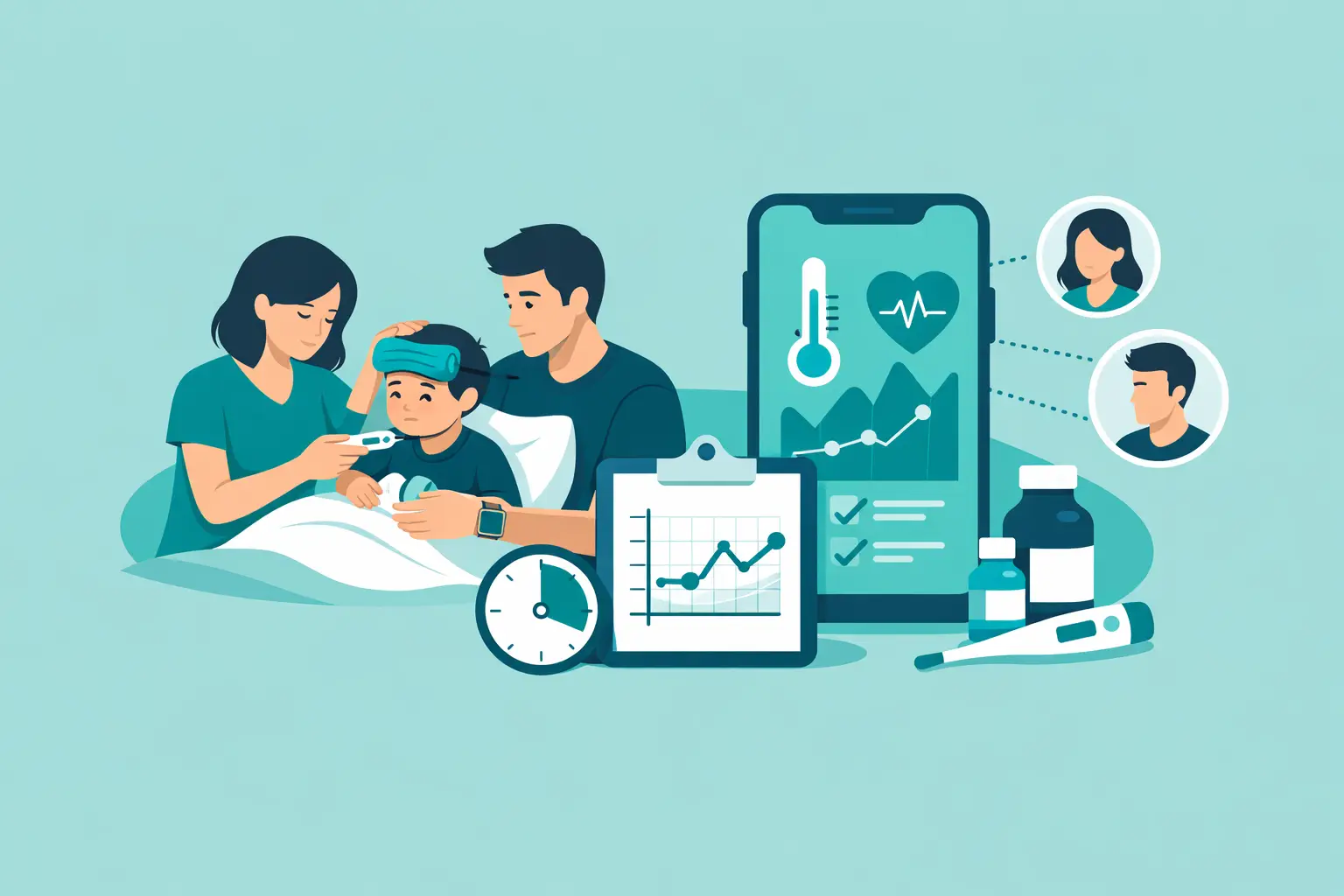
When someone in the house is sick, the hardest part is often not taking a temperature. It is remembering what happened at 2:00 a.m., knowing whether another caregiver already logged a reading, and finding the full story when a family member asks for an update. A family fever tracking guide gives your household one clear process for recording what you observe and sharing it without guesswork.
This is not about turning your home into a clinic. It is about replacing scattered notes, text messages, and tired memories with a calm record that supports shared care. A well-organized illness log can lower the mental load when the household is already under stress.
Why family fever tracking matters
A single temperature reading is a moment in time. What caregivers often need is context: when it was taken, whose reading it was, what else was happening, and whether another person in the household has already checked in. Without that context, it is easy for details to get lost between school pickup, work calls, overnight care, and handoffs between parents, grandparents, or other trusted caregivers.
Tracking also creates a more reliable household timeline. Instead of asking, “Do you remember when that started?” you can review a record built as events happened. That is useful for your own coordination and can make it easier to communicate accurate observations to a healthcare professional when needed.
The goal is clarity, not constant monitoring. Every family and illness situation is different, so the right level of detail depends on your household’s needs, your existing care plan, and any guidance you receive from a qualified professional.
Set up one simple tracking routine
The best tracking system is one your family can actually maintain when everyone is tired. Start by deciding where the record lives and who can update it. A shared digital tracker is often easier than a paper note because caregivers can see the same current information from wherever they are.
Create a separate profile or tracking space for each family member. This matters in homes where more than one person is unwell. Mixing entries between siblings or between a child and an adult creates avoidable confusion, especially when readings and symptoms are similar.
For each entry, capture the same basic details:
- The family member’s name
- The date and time of the reading
- The temperature reading and measurement method, if your household records it
- Observed symptoms or changes in comfort, energy, eating, drinking, sleep, or behavior
- Notes about caregiver handoffs, appointments, or questions to raise with a professional
Consistency matters more than complexity. A short, clear note entered at the right time is more useful than a detailed entry reconstructed hours later.
Choose a shared source of truth
A group text can be useful for quick updates, but it is not a dependable health record. Messages disappear in conversation, timestamps are easy to overlook, and a new caregiver may not see the full thread. Paper notes have a similar limitation: they only help if the right person can find them.
Choose one household source of truth and make it known. Tell everyone who may provide care where to check before recording a new entry. The routine can be as simple as: check the log, add the current observation, and leave a brief handoff note if another caregiver is taking over.
Medication Timer is designed around this kind of shared household coordination, bringing illness tracking, health readings, and caregiver visibility into one private place. The value is not more data for its own sake. It is knowing that the details your family needs are organized and available.
Make each entry useful at a glance
A fever log becomes valuable when it answers practical questions quickly. Someone reviewing it should be able to see the order of events without scrolling through paragraphs of text. Keep notes factual and use plain language.
For example, instead of writing “seems worse,” record the observation behind that impression: “rested most of the afternoon,” “woke several times overnight,” or “caregiver change at 6:30 p.m.” These notes do not need to be clinical. They simply preserve what your family observed at a specific time.
Avoid trying to interpret every change in the log. Your tracker is a record, not a diagnostic tool. If you have questions or concerns about a family member’s condition, use the information you have recorded when speaking with an appropriate healthcare professional or following your family’s existing care plan.
Keep timing clear
Timing is one of the most important parts of any illness record. A number without a date and time has limited value. A note without a name can be worse than no note in a busy household.
Use a consistent time format, and enter readings as close to the observation as possible. If you are adding something later, label it as a backfilled note so another caregiver understands when the event occurred versus when it was recorded. That small distinction prevents accidental assumptions during a handoff.
It also helps to keep routine care tasks separate from illness observations while still viewing them in the same family system. When a household is managing ongoing schedules alongside a short-term illness, separate but connected records reduce the risk of overlooking either one.
Coordinate caregiver handoffs without repeating work
Illness care rarely happens in one uninterrupted shift. One caregiver may handle the morning, another may take over after work, and a grandparent or trusted relative may step in during an appointment or overnight. Each handoff is a point where important details can slip away.
Before leaving, the outgoing caregiver can add a short note that answers three practical questions: What was last observed? What is planned next under the household’s existing routine? Is there anything the next caregiver should watch for or communicate? The incoming caregiver can then read the record before asking questions that may already be answered.
This approach also reduces duplicate work. Nobody needs to take another reading simply because they cannot tell whether one was already recorded. Nobody has to search through messages to find the last update. The record becomes a quiet form of teamwork.
In shared-care situations, access and privacy deserve equal attention. Only invite people who are genuinely involved in care, and review who can see a family member’s information. A family health tool should create confidence without turning private details into household chatter.
Build a record that is easy to share when needed
A useful family record should be easy to review, not just easy to collect. During a conversation with a healthcare professional, caregivers may be asked about the timing of observations, related symptoms, or changes over a period of time. A chronological log helps you describe what your household noticed without relying entirely on memory.
Keep the original entries intact when possible. If something needs clarification, add a new note rather than rewriting the past. A clear sequence is more helpful than a polished narrative.
You may also want to add non-medical context that affects coordination, such as whether a child stayed home from school, which caregiver is available the next day, or whether another household member is experiencing symptoms. These details can help the family plan while keeping the health record focused.
Know when tracking has done its job
More tracking is not always better. The purpose of a fever log is to support awareness, communication, and organized caregiving. If your system becomes so detailed that it adds stress or keeps caregivers from resting, simplify it.
A good record lets you look at the household situation and feel oriented. You know who has been checked on, what has been observed, and what the next caregiver needs to know. When you need professional support, you have a factual timeline ready to share. When the illness period passes, you can close the tracking session and return to everyday routines.
The most helpful family health system is the one that stays dependable when life is not. Give every caregiver one trusted place to record the moment, understand the handoff, and focus on the person who needs care.