A fever at 2 am, a rushed school morning, a grandparent’s appointment, a partner working late: family care rarely happens when everyone is calm and available. A medication history log gives caregivers one clear record of what has been tracked, when it was recorded, and who handled it. That clarity can reduce second-guessing when the household is busy.
For many families, medication information lives in too many places: a note on the fridge, a text thread, a bottle on the bench, and someone’s memory. That system may work until another caregiver steps in or an illness creates more moving parts. A shared, organised history turns scattered details into a dependable household record.
What a medication history log does for a family
A medication history log is a running record of medication-related activity for each person in your care. It can show scheduled routines, as-needed entries, timing, and the caregiver who logged the event. Rather than relying on memory or asking, “Did anyone handle this already?” caregivers can check one trusted place.
Its value is not just organisation. A clear history supports safer handovers between parents, guardians, relatives, and other caregivers you trust. It makes the day easier to reconstruct when routines are interrupted by school, work, travel, or a sick child who needs extra attention.
The right log also separates each family member’s information. That matters in households where several people have different routines. A record that is easy to scan helps prevent one person’s details from being confused with another’s.
What belongs in a medication history log?
The most useful logs are detailed enough to answer practical questions, but simple enough that caregivers will actually use them. Start with the medication name as it appears on the label, the family member it belongs to, and the routine or schedule associated with it.
Each logged entry should capture the date and time, along with a clear status such as taken, skipped, or not yet confirmed. If your household uses as-needed medications, record the time of each entry, so another caregiver can understand what happened without searching through texts.
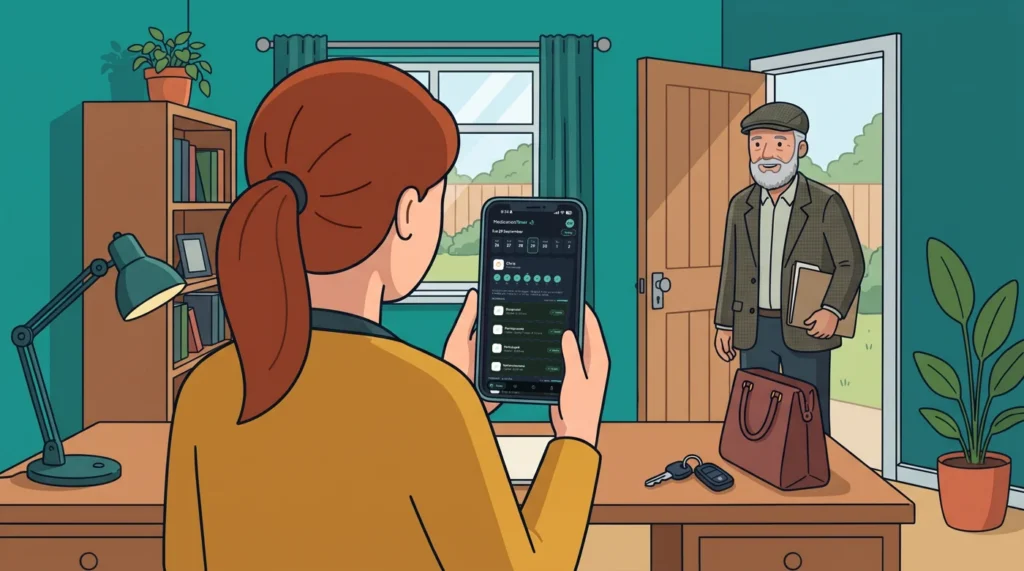
In Medication Timer, every dose and reading you log is saved with its time, and if you log a temperature a little after the fact, you can set the time it was actually taken. On Today, each person’s scheduled doses show as taken or skipped, so a dose that was skipped on purpose is easy to tell apart from one that was never logged. Free accounts see full detail for the last three days, and Family Care keeps the full calendar history (Free + more with Family Care).
Caregiver identification is especially helpful in shared-care homes. Knowing who recorded an entry helps avoid duplicate work and makes communication more straightforward. It also helps to keep the non-clinical context in mind, such as whether a child was at school, whether a caregiver was away from home, or whether a routine was paused during travel.
Keep the log focused. A long free-form journal can become hard to use when someone needs an answer quickly. The goal is a clean, chronological record that supports everyday coordination, not a complicated chart that creates more work.
Why paper records often break down
A paper log can be useful as a backup, especially during a power outage or a short-term situation. But paper has predictable limits in an active household. It may stay in one room, get misplaced, or fail to reach the person who needs it most.
Text messages solve the distance problem but introduce a different one: information gets buried. A caregiver may send an update, another person may respond hours later, and the family is left scrolling through a crowded conversation to find a single time stamp. That is not the kind of task anyone wants during a stressful night.
A digital medication history log keeps the record current and visible to the right people. It can also connect the history to reminders, recurring routines, and family-member profiles, so caregivers do not have to rebuild context every time they open the app.
Build a medication history log that people will use
The best system is the one your family can maintain on an ordinary Tuesday. Start by adding only the routines and family members you actively manage. If you try to document every health-related detail at once, the process can feel overwhelming and the log may be abandoned.
Make ownership clear from the beginning. Decide who will log routine updates, which caregivers to invite to the shared record, and how your household will handle a missed or unconfirmed entry. Families do not need rigid rules for every situation, but they do need a shared understanding that an unlogged event is not the same as a confirmed one.
Use reminders to prompt action, then use the history to confirm completion. These are different jobs. A reminder tells a caregiver that a task is due. The log creates the household record of what happened afterwards. Keeping both functions in one place removes a common source of confusion.
Review the setup whenever a routine changes, a new caregiver joins, or a family member’s needs shift. Old entries should remain available as history, while active routines should stay easy to recognise. A clean system protects attention, which is often in short supply when illness strikes.
Create separate records for each person
A household record should never require guesswork about whose information is being viewed. Separate profiles create cleaner histories and make it easier to scan active routines for a child, spouse, parent, or other family member.
This is particularly valuable when names, containers, or schedules look similar. A family-centred tool should make it obvious who an entry belongs to before a caregiver records anything.
Keep caregiver updates in one shared place
Care coordination is often less about one person doing everything and more about everyone seeing the same information. When a parent leaves for work, a grandparent takes over after school, or a partner handles bedtime, the history should travel with the care responsibility.
A shared log reduces the need for repeated check-in messages while still preserving accountability. It gives caregivers a calm way to confirm what has been recorded without interrupting each other throughout the day.
In Medication Timer, each caregiver you invite signs in with their own login, and you can revoke access when a helper no longer needs it (Family Care). Once your household is shared, timer cards show who logged the last dose and when, so the grandparent on the after-school shift can check what has already been given without sending a text.
During illness, history becomes context
Routine care is one thing. Illness can add temperature readings, symptoms, changing schedules, interrupted sleep, and multiple caregivers checking in from different places. In those moments, a medication history log works best when it sits alongside the broader picture of what the household is tracking.
For example, a family may need to see a chronological view of logged medication events alongside time-stamped readings and symptoms. The benefit is not interpretation or diagnosis. It is having a clear, accurate record that helps the family communicate and stay organised when details are easy to lose.
Medication Timer is designed around this household reality. It gives families one place to track medications, run as-needed timers, build routines and log readings for each family member. When someone is unwell, you start a Care session for that person, and their as-needed timers, temperatures and symptoms sit together on one timeline. When they are feeling better, you can end and archive the session, so the illness stays in their history without cluttering everyday routines (Free). The focus is practical: every dose, every family member, one trusted place.
Privacy is part of safe organisation
A family health log can contain sensitive information, so convenience should not require giving up control. Before choosing a digital tool, look at how sharing works and whether the company’s business model respects health privacy.
Families should be able to share information intentionally rather than broadly. A useful system lets the right caregivers stay informed while keeping household records away from public feeds, advertising profiles, and unnecessary third parties.
That privacy matters because a log is most helpful when caregivers feel comfortable using it consistently. Trust encourages accurate records. Accurate records make coordination easier.
A record your family can rely on
A medication history log cannot remove every stressful moment from family care. It can, however, replace scattered reminders and uncertain recollections with a record everyone can understand. When the next handover happens, whether at the kitchen bench, in the school pick-up line or late at night, the most helpful detail may be the one that was clearly logged when it happened.
Questions? Browse the help centre or contact support from Profile in the app.