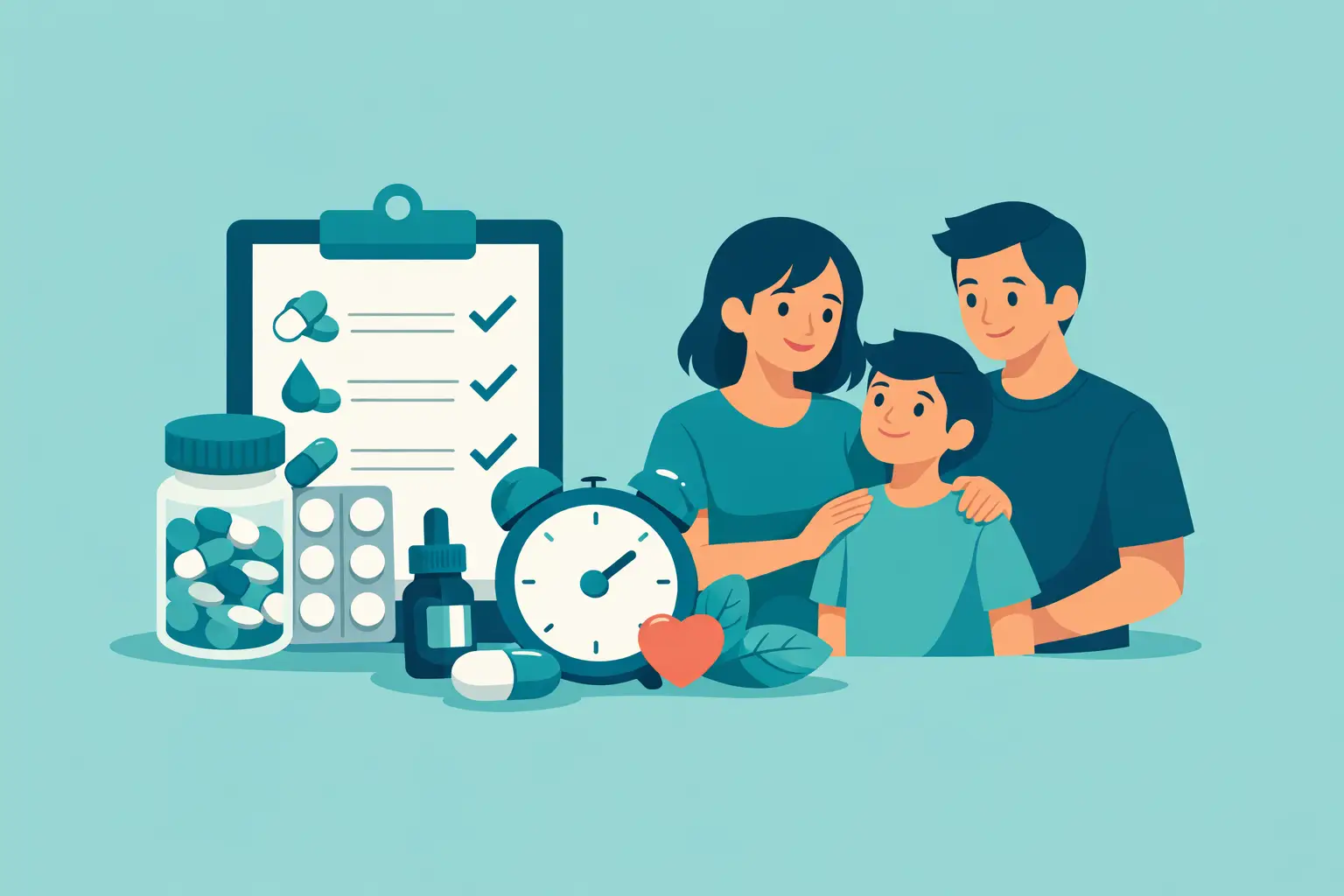
The hardest part of a busy morning is rarely remembering that someone has a medication. It is knowing whether it has already been given, whether another caregiver handled it, and whether the schedule changed while everyone was rushing out the door. A daily medicine routine checklist gives your household one clear record instead of relying on memory, sticky notes, or a string of text messages.
For families managing care for children, adults, or older relatives, the goal is not to make home health management feel clinical. It is to create a dependable rhythm: every person, every routine, and every update in one trusted place.
Start With a Separate Profile for Each Family Member
A household checklist works best when it is built around people, not around a pile of medication bottles. Create a distinct profile for each person whose routine you help manage. This keeps names, schedules, notes, and health readings from blending together when more than one family member needs attention.
For each profile, record the information that helps a caregiver identify the routine quickly: the family member's name, the medication name as shown on its label, the routine timing, and any caregiver notes that are useful for coordination. Keep those notes practical. A note such as “packed for school days” or “kept in the kitchen cabinet” can prevent a frantic search without trying to replace official instructions.
This separation matters most when family members have similarly named products, overlapping schedules, or different caregivers. A clear profile answers the first question everyone has: whose routine am I looking at?
Build the Daily Medicine Routine Checklist Around Real Life
A schedule that only works on a perfect weekday will not protect your family when the morning runs late or a grandparent takes over after school. Anchor your daily medicine routine checklist to the moments your household already recognizes, such as waking up, leaving home, returning from school, dinner, or bedtime.
Use consistent routine names instead of vague labels. “Morning before school,” “after-work check-in,” and “bedtime routine” are easier for a shared household to follow than a list of times with no context. Timing still matters, but meaningful labels make the schedule easier to recognize at a glance.
Your core checklist should make room for these four details:
- The family member and medication involved
- The planned routine window or reminder time
- A clear status showing completed, pending, or skipped
- The caregiver who recorded the update, when shared care is involved
That last detail is often what turns a reminder into a reliable household system. When one person can see that another caregiver has already logged the routine, there is less need to ask, guess, or repeat a dose accidentally.
Make Completion Visible, Not Assumed
A reminder can prompt action, but it cannot confirm what happened. The checklist needs a simple way to mark each routine as complete at the moment it is handled. This creates a record that is much more useful than a notification that disappears from a lock screen.
Avoid marking an item complete in advance just to clear the list. A clean screen can feel satisfying, but the record should reflect what actually happened. If a routine was not completed or needs follow-up, leave a clear status and a short note for the next caregiver.
This approach also makes transitions easier. One parent may handle the morning routine, a sitter may cover the afternoon, and another parent may be home at night. Each person can open the same checklist and see the current status without reconstructing the day from memory.
Add Safety Timers for As-Needed Routines
Some household medication tasks do not belong on a fixed daily schedule. They may be used only when needed, which makes timing and communication especially easy to lose track of during an illness or a sleepless night.
For these situations, use a safety timer that records when the item was logged and shows when it is time to review the next possible step according to the directions provided by the relevant healthcare professional or product label. The value is not in asking caregivers to do more mental math. It is in giving the household a shared, timestamped record.
A good as-needed entry should show the family member, the time it was recorded, and the caregiver who logged it. If another caregiver takes over, they can see the recent history before making any decisions. When there is uncertainty about instructions, timing, or a missed entry, pause and contact an appropriate healthcare professional or pharmacist rather than relying on a checklist to interpret medical guidance.
Create a Handoff Routine for Shared Caregivers
Care coordination breaks down in the gaps between people. The morning caregiver assumes the evening caregiver knows what happened. The evening caregiver assumes the school nurse, babysitter, or visiting relative has the same information. A daily checklist can close that gap, but only if everyone follows the same handoff habit.
At each transition, take a brief look at the household dashboard together or send a clear update through your agreed family channel. Confirm what has been completed, what remains pending, and whether there are any notes that need attention. Keep the handoff factual and short.
For example, a caregiver update might say: “Jordan’s morning routine is logged. The evening reminder is still pending. Temperature was recorded at 3:15 p.m.” That is enough to orient the next person without turning routine care into a complicated report.
If your household has several caregivers, decide who is responsible for updating the checklist after each routine. Shared visibility is helpful, but shared responsibility without a process can still lead to assumptions. A simple rule such as “the person who completes it logs it” keeps the record current.
Include Health Readings and Illness Notes in the Same Place
When illness strikes, families often end up with a separate paper for temperatures, another note for symptoms, and medication reminders scattered across phones. That fragmentation adds stress at exactly the time you need clarity.
Your checklist can include a linked space for health readings and brief observations, organized by family member and date. Record what you observed, when you observed it, and who entered the information. Use plain language and avoid trying to draw conclusions from the data. The purpose is a reliable timeline that caregivers can reference and share with a healthcare professional if needed.
An illness-specific tracking session can be especially useful for keeping a temporary burst of information separate from everyday routines. Once the situation passes, your regular schedule remains easy to read instead of buried under days of notes.
Review the Checklist Once a Week
A daily system stays dependable when it gets a quick weekly review. Choose a calm moment, not the middle of a rushed handoff, to check whether reminders still match your household's routine and whether caregiver access is current.
Look for duplicate entries, outdated notes, schedules that no longer fit school or work days, and family profiles that need to be updated. Confirm that everyone who helps with care knows where the checklist lives and how to log completion. If a family member no longer needs a routine on the active list, archive it rather than leaving it to create confusion later.
This review is also a good time to check the physical organization around the routine. Make sure the items used in your household are stored according to their labels and that the information in your checklist matches what caregivers see. The digital record and the real-world routine should support each other.
Keep Privacy Part of the Routine
Family health information deserves more care than a shared note app with unclear access settings. Choose a system that lets the right caregivers see the information they need without exposing it to unnecessary people, advertising systems, or scattered personal accounts.
Medication Timer is designed for this kind of family coordination: multiple family members, shared caregiver visibility, recurring routines, as-needed safety timers, and illness tracking in one privacy-focused place. The benefit is not more alerts for their own sake. It is a clearer record when your household needs one.
A checklist cannot remove every question from family care, and it should never replace professional guidance. What it can do is replace avoidable uncertainty with a calm, shared view of what has been logged, what is next, and who is handling it. On the days when everyone is well, that means less mental load. On the days when care becomes more demanding, it gives your family a dependable place to begin.