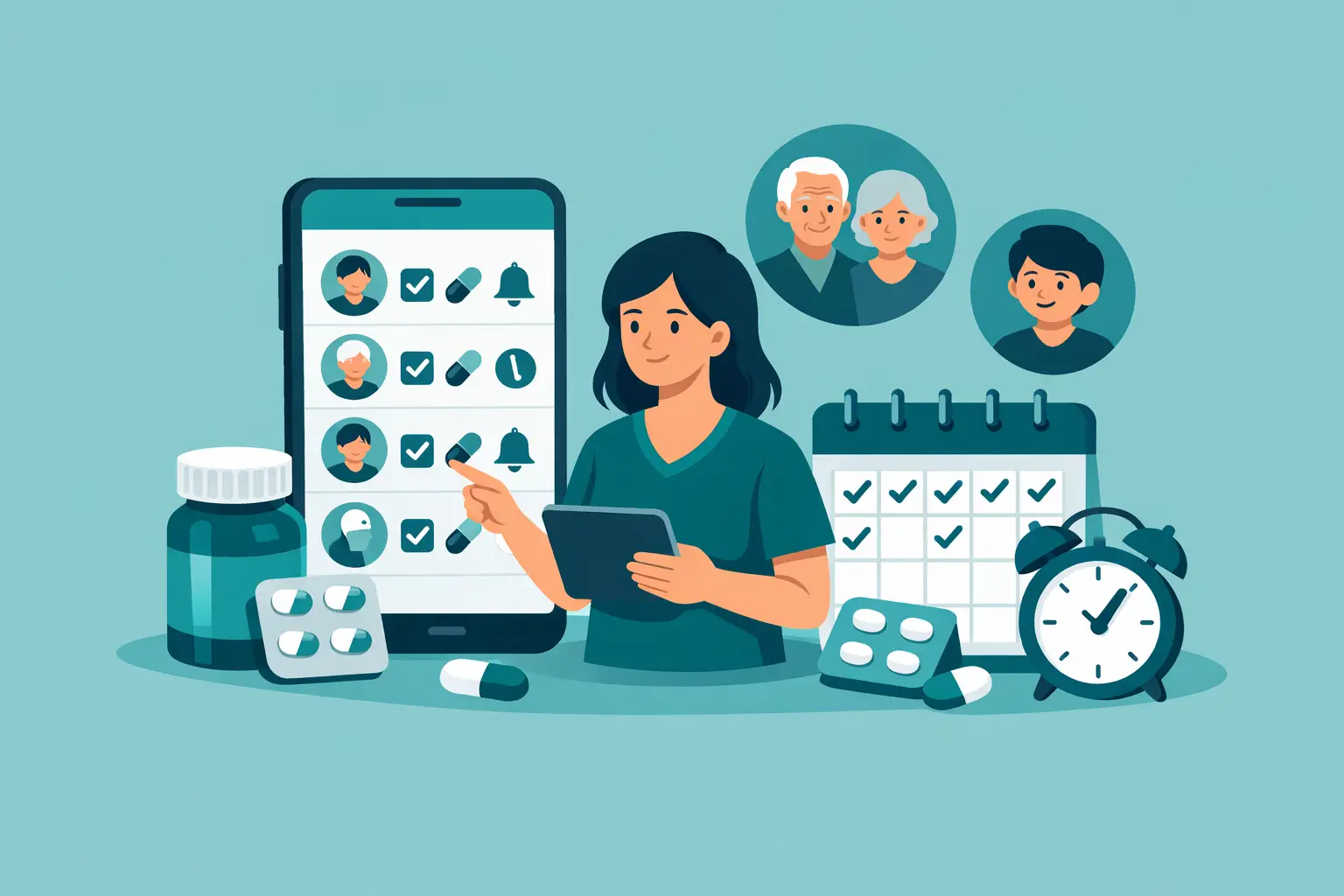
A family medication tracker review should begin with the moment families actually need one: it is late, someone is unwell, one caregiver has stepped out, and nobody wants to rely on a vague memory of what happened and when. The right system does more than send reminders. It gives the household a clear, shared record when details matter most.
For parents, guardians, and caregivers, that clarity can reduce the constant mental work of keeping track of routines across several people. A good tracker should make everyday organization feel lighter while staying dependable during a difficult week at home.
What a Family Medication Tracker Should Actually Solve
Many reminder apps are built around one person and one schedule. That can work for a simple personal routine, but family care is rarely that simple. A household may be tracking different routines for children, a partner, an aging parent, or a relative who needs support. Responsibilities may also shift between parents, grandparents, babysitters, or other trusted caregivers.
The central question is not simply, “Will this app remind me?” It is, “Can everyone responsible see the same trustworthy information without creating more confusion?”
A useful family tracker should bring schedules, completed entries, and relevant health observations into one place. When one caregiver records an event, another should be able to see it promptly. That shared visibility helps prevent duplicate work, missed handoffs, and the familiar uncertainty of wondering whether someone else already handled it.
It should also work in two very different modes. During ordinary weeks, it needs to support predictable routines without becoming another noisy app. When illness strikes, it needs to make it easier to record what is happening over time, without forcing a family to sort through scattered texts, paper notes, and memory.
Family Medication Tracker Review: Features That Matter
The most valuable features are often the ones that reflect real household behavior rather than clinical paperwork. Here is what to look for when comparing options.
Support for every family member
A family system should not limit care organization to one profile or make you create awkward workarounds for each person. Separate profiles keep each person’s routines and logs distinct while allowing an authorized caregiver to view the household picture.
This matters because names, schedules, and records can start to blur when families are moving quickly. Clear profiles provide a small but meaningful layer of protection against mix-ups. For larger or multigenerational households, unlimited family member support can be especially useful.
Shared caregiver access with clear status
Sharing is not just about letting another person open an app. The useful part is seeing whether something has been recorded and when. A tracker should make completed items easy to distinguish from upcoming ones, so a caregiver does not have to send a stream of check-in messages throughout the day.
Look for controls that allow families to share access with the people who genuinely help with care. The best experience feels coordinated, not crowded. Every caregiver should understand what they can see, what they can add, and where the current record lives.
Timers designed for as-needed tracking
Routine reminders handle repeating events well, but they do not always solve the timing questions that arise when care is less predictable. Safety timers can provide a visible reference point for when something was last logged and when the next timing window may be available according to the plan a family is following.
This is not a substitute for directions from a qualified healthcare professional or the information provided with a product. It is an organizational safeguard: a way to preserve an accurate household record instead of asking a tired caregiver to reconstruct a timeline from memory.
Illness sessions and health readings in context
A standard checklist is often too limited when a family member is sick. Families may want to log temperatures, symptoms, hydration notes, rest, and other readings or observations over the course of an illness. The value is not in collecting data for its own sake. It is in creating a readable timeline that helps caregivers communicate clearly with one another.
An illness-specific session keeps those entries together rather than mixing them into an endless general notes feed. This approach is particularly helpful when responsibilities rotate overnight or across several days. It gives the next caregiver context before they begin, rather than leaving them to piece together what has changed.
Privacy that fits the responsibility
Health information is personal, even when it is being managed within a family. A tracker should be straightforward about how information is handled and should avoid making families trade privacy for basic organization.
No advertising and no sale of health data are meaningful signals for a household care tool. Families should also consider whether sharing controls are easy to understand, whether the account can be managed without technical expertise, and whether the experience stays focused on care instead of promotion.
Where Trackers Can Fall Short
A review should be honest about trade-offs. No app can take responsibility for a household, interpret health information, or replace professional guidance. The purpose of a tracker is to organize the facts a family chooses to record and make that record easier to share.
The feature-rich option is not automatically the best one. Some platforms add extensive reporting, complicated setup, or tools meant for clinical teams. Those may be useful in certain situations, but they can also create friction for a parent who simply needs a clear schedule, a recent history, and confidence that another caregiver can step in.
On the other hand, a very basic reminder app may feel easy at first but become limiting when more than one person needs access. If it cannot separate family profiles, show completed entries, or support illness tracking, the family may still end up maintaining a second system through text messages or handwritten notes.
Notification design is another trade-off. Too few prompts can leave a routine easy to overlook. Too many can lead to notification fatigue, especially in a busy household. The best tracker lets families establish practical routines and provides timely visibility without turning a phone into a constant source of alarm.
A Practical Way to Compare Your Options
Before committing to an app, think through one normal weekday and one unexpectedly busy illness day. Can you add every person who needs to be tracked? Can a trusted caregiver quickly understand what has already been logged? Can you see the latest entry without searching through messages?
Then consider setup. A system is only protective if the family will actually use it. It should be simple to add routines, record events, and review a timeline. If the process takes too many screens or uses unclear language, the household may abandon it when life becomes hectic.
It also helps to decide what “shared” means for your home. Some families need two parents to coordinate. Others need a broader circle that includes grandparents or other caregivers. Choose a tool whose sharing model matches your real care network, not just the ideal version of it.
Medication Timer is built around this household-first model, combining family profiles, shared coordination, recurring routines, safety timers, and illness tracking in one privacy-conscious place. Its Family Care option can make sense for households that need expanded capabilities, while a free option gives families a way to see whether the workflow fits their daily routine.
The Best Review Is the One That Matches Your Household
The right choice depends on how many people are involved, how often caregiving responsibilities change, and whether your family needs support beyond a simple daily reminder. A single adult managing one consistent routine may need very little. A household coordinating care across children, partners, relatives, and rotating caregivers benefits from a more complete shared system.
Look for clarity over complexity. The strongest family medication tracker is not the one with the longest feature list. It is the one that helps the right person see the right record at the right moment, with less uncertainty and less back-and-forth.
When family care is organized in one trusted place, the goal is not to make every day feel medical. It is to leave more room for the people in your home and less room for preventable confusion.