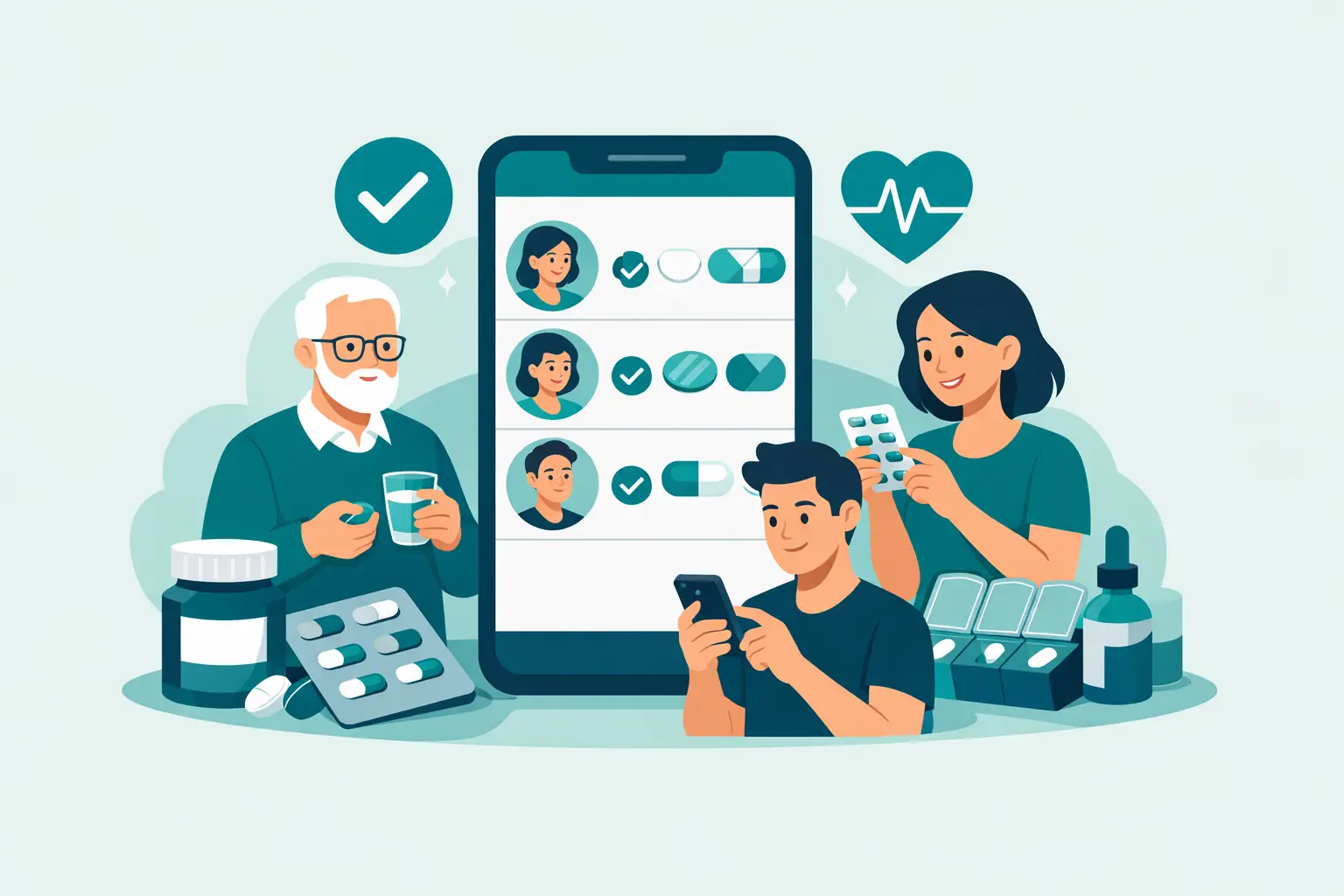
You notice the problem when the house gets busy. One child has a fever, a parent needs a daily refill reminder, someone else took an as-needed dose two hours ago, and now two caregivers are texting different versions of the same update. A medication tracker for multiple people is not just a convenience in that moment. It is the difference between guessing and knowing.
For families, the challenge is rarely one medication for one person. It is overlapping routines, changing illness days, shared responsibility, and the constant need to remember what happened, when it happened, and who handled it. That is why household medication management needs a different standard than a single-user reminder app.
What a medication tracker for multiple people should actually solve
Most tracking tools work fine if you are only thinking about one person and one schedule. Family care is different. The real problem is coordination.
You are not only trying to remember a recurring dose. You are trying to keep each family member separate, avoid confusion between names and schedules, and make sure another caregiver can step in without needing a full handoff. When illness strikes, the pressure goes up quickly. Timers matter more. Symptom notes matter more. So does being able to check one trusted place instead of relying on memory.
A useful system should reduce mental load, not add another task. If it takes too many taps, hides key details, or forces caregivers to build workarounds, it stops being protective. Families need something that keeps the household organized without feeling clinical or hard to maintain.
Why single-person apps often break down in family care
A lot of medication apps were built around an individual user. That makes sense for personal wellness, but it creates gaps in a shared-care household.
The first issue is visibility. If one person manages everyone through a single profile or a notes app, records can blur together. That may seem manageable on a calm day, but it becomes risky when multiple medications, symptoms, or readings are being tracked at once.
The second issue is caregiver sharing. In real life, care gets handed off. One parent starts the morning. Another handles pickup. A grandparent helps in the afternoon. If updates live in texts, paper notes, or someone’s memory, there is always room for confusion.
The third issue is timing. Recurring reminders are only one part of the picture. Families also need safety timers for as-needed doses so nobody has to stop and calculate whether enough time has passed. During a stressful night, that kind of clarity matters.
The features that matter most in a family setting
The right medication tracker for multiple people should separate each person’s schedule clearly while still keeping the household connected. That balance is what gives families peace of mind.
Each family member should have their own profile, routine, and history. That sounds basic, but it changes everything. It becomes much easier to check who took what, see what is coming up next, and avoid mixing one person’s care with another’s.
Shared caregiver access is just as important. A family system works better when updates are visible across the people involved in care. Instead of asking, “Did anyone give that already?” caregivers can confirm the record and move forward with confidence.
Timers and logs also need to work together. A reminder tells you something is due. A timer helps you know when enough time has passed. A log confirms what already happened. Families usually need all three, especially during short-term illness when routines change from hour to hour.
It also helps when the platform can track more than medication events alone. During illness, many families are also watching symptoms, temperature checks, or other basic readings. Keeping those details in the same place creates context. It turns scattered updates into a timeline that is easier to follow and share.
One place beats five partial systems
Many households already have a patchwork system. A calendar reminder on one phone, a paper note on the counter, a text thread with updates, maybe a spreadsheet for the most organized person in the house. It works until it does not.
The problem with partial systems is that they depend too much on one person holding everything together. If that person gets busy, leaves the house, or simply forgets to update one step, the whole process weakens.
A centralized tracker gives families a steadier foundation. It puts every dose, every family member, and every update in one place. That does not remove the realities of caregiving, but it makes them easier to manage. Instead of chasing information, caregivers can act on it.
This is especially useful during periods when care becomes temporary but intense. A seasonal illness can turn a normal household into a round-the-clock coordination effort. In those moments, order is not a nice extra. It is what helps everyone stay calm and consistent.
How families use a medication tracker for multiple people day to day
On routine days, the value is simple. Daily medications, household health routines, and recurring reminders become easier to manage without relying on memory alone. A parent can see what is due next. A spouse can confirm that something was already handled. A caregiver can log a reading and move on with the day.
On illness days, the same system becomes a shared command center. Families can start a focused tracking period, log doses and symptoms as they happen, and keep everyone aligned without repeating information in multiple places. That kind of structure helps reduce second-guessing.
There is also a less obvious benefit. Good household tracking lowers the emotional strain of caregiving. When you do not have to carry every detail in your head, you can spend more attention on the person who needs care. The system handles the remembering so the caregiver can stay present.
Privacy matters more than people think
Health tracking is deeply personal, especially when it involves children, aging parents, or multiple people under one roof. Families are right to care about where that information goes.
A family health tool should treat privacy as part of safety. That means clear control over shared access and a business model that does not depend on turning private health information into marketing fuel. For many households, trust is not a bonus feature. It is the first filter.
When a platform is built for families, privacy should feel straightforward. You should know who can see updates, where records live, and whether the service respects the sensitivity of what you are tracking. Calm systems build trust by being clear, not by burying those details.
Choosing the right fit for your household
Not every family needs the same level of tracking. Some need simple recurring reminders for a few people. Others need a more complete system that can support rotating caregivers, short-term illness tracking, and household-wide visibility.
The best fit depends on how care actually happens in your home. If one person manages nearly everything and schedules rarely change, a basic setup might be enough for now. If care is shared, interruptions are common, or more than one family member needs active tracking, a family-first system will usually hold up better.
Look for clarity before complexity. Can you tell at a glance whose record you are viewing? Can another caregiver step in without needing a phone call? Can you log events quickly when the day gets chaotic? Those are practical signs that a tool will help in real life, not just in a product demo.
Medication Timer is built around that household reality, with support for multiple family members, shared caregiving, recurring routines, illness tracking, and privacy-first organization in one place.
A medication tracker for multiple people should do more than send reminders. It should bring order when routines are steady and calm when they are not. Families do enough already. The right system gives them one trusted place to keep care clear, shared, and easier to manage.