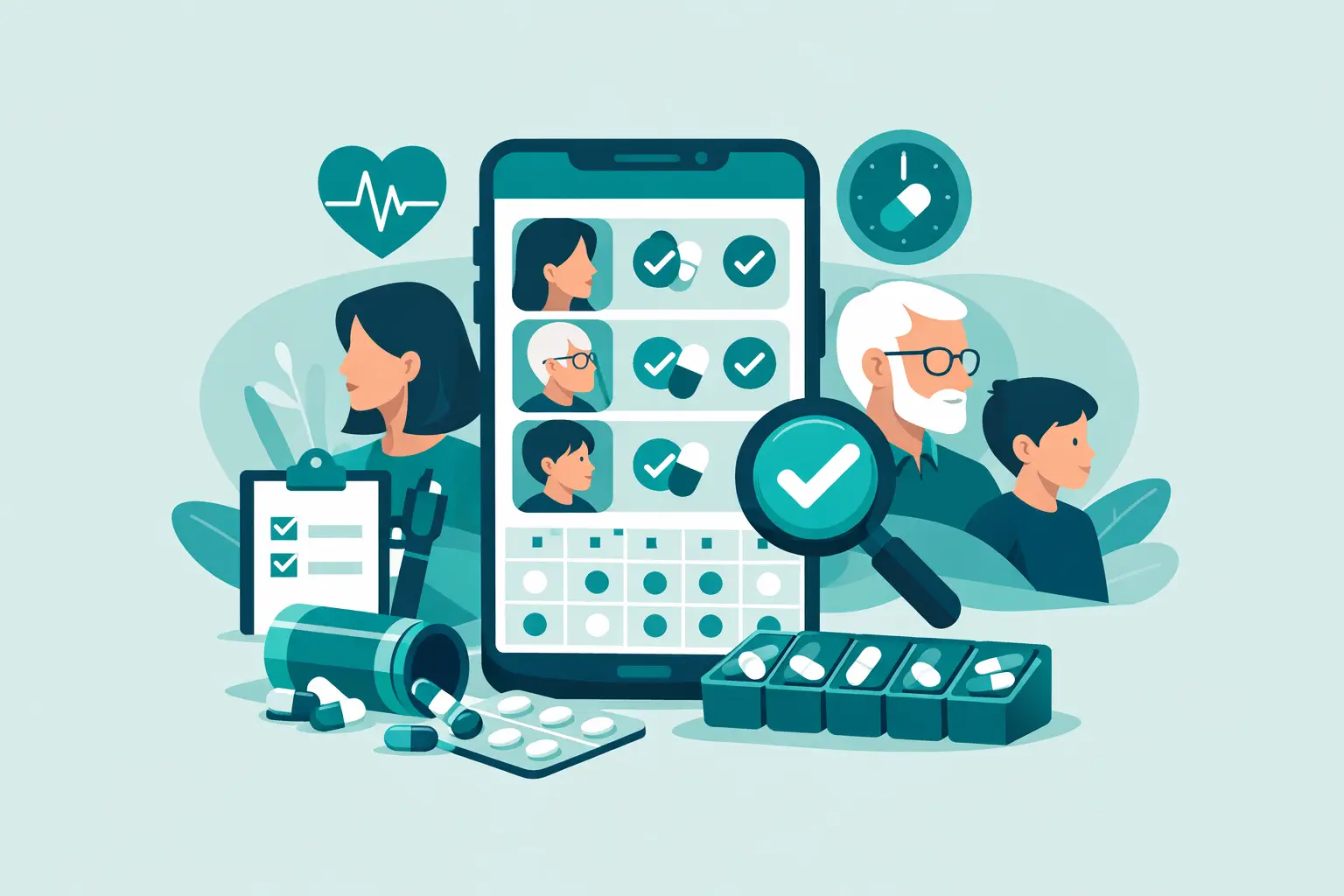
If you have ever stood in the kitchen wondering who already got their dose, when the last fever reading was taken, or whether another caregiver handled it, you already know the problem. Trying to track medications for multiple people is not just an organization task. It is a safety task, and the stakes feel higher when a child is sick, an older parent needs routine support, or the whole household is running on too little sleep.
Most families do not struggle because they are careless. They struggle because the information is scattered. A reminder lives on one phone, a temperature note is scribbled on paper, a spouse sends a text, and a bottle is left on the counter as a vague signal that something may have happened. That system can hold together for one person, for a while. It usually breaks down when care is shared.
Why it gets hard to track medications for multiple people
The challenge is not only the number of medications. It is the number of moving parts around them. Different people may have different routines, different timing windows, different symptom notes, and different caregivers involved. Even in a well-organized home, the mental load adds up quickly.
Routine care and sick-day care also create different kinds of pressure. Daily medications require consistency over time. Illness care requires quick checks, more frequent logging, and close coordination. When both are happening at once, families often switch between memory, texts, paper notes, and bottle labels. That is where confusion starts.
There is also a trade-off many caregivers feel but do not always say out loud. The more carefully you try to track everything, the more work it can become. A good system has to protect safety without turning into another job.
What a family-safe tracking system should do
A usable system should answer simple questions fast. Who is this for? What was given? When was it logged? Who recorded it? Is anything due soon? If someone in the household is sick, it should also help you keep related readings and symptom notes in the same place so you are not piecing together the story later.
For most families, the best setup is one trusted place for every family member rather than separate tools for each person. That matters because households do not operate in neat categories. The same caregiver may be handling a child with a fever, a partner's routine medication, and an elderly relative's reminders all in the same day.
Shared visibility matters just as much as reminders. A reminder that only one person can see does not solve much when caregiving is split between parents, partners, grandparents, or other helpers. Real coordination happens when everyone involved can see the same record and act from the same information.
Start by organizing each person separately
The easiest way to reduce mix-ups is to treat each family member as their own profile or record. That sounds obvious, but many household systems fail because they rely on one combined note or one caregiver's memory. Separate records create clarity before you even set a single reminder.
For each person, keep the basics together in one place: the medication name, the schedule or timing pattern, and any household notes that help caregivers stay aligned. If you also track temperatures or other readings during illness, keep those attached to the right person so they do not blend into someone else's care history.
This is where family-focused software has a real advantage over general reminder apps. A standard reminder tool may tell you something is due, but it often does not reflect the reality of multi-person care. A household system is built around people first, not just alerts.
Build routines for the predictable parts
Families usually need two kinds of tracking: recurring routines and as-needed support. Recurring routines are the backbone of medication organization. They reduce decision-making because the pattern is already set, and caregivers can quickly see what belongs in the normal rhythm of the day.
Morning, after-school, bedtime, and weekly refill check-ins are common anchors because they match how real households move. The goal is not to create a perfect schedule. It is to tie care tasks to moments that are already easy to remember.
Consistency helps in another way too. When a routine is visible and shared, a missed task is easier to catch early. That lowers the chance of duplicate logging or uncertainty later in the day.
Use timers and logs for the unpredictable parts
As-needed care is where many families feel the most stress. During illness, the problem is rarely just remembering that something was given. The harder part is knowing exactly when it happened and whether enough time has passed before another dose is considered. In a tired household, guessing is not good enough.
That is why timers and dose logs matter. A timer adds protection in the moment. A log adds context afterward. Together, they give caregivers a quick way to check what happened without replaying the day from memory.
This is especially useful when multiple adults are helping. One person may handle the morning rush, another the afternoon pickup, and another the overnight wake-up. If each action is recorded in one shared place, the household can move from uncertainty to confidence.
Keep illness tracking connected to medication tracking
When illness strikes, medication tracking often expands into symptom tracking, temperature checks, and general household monitoring. If those details live in different places, it becomes harder to understand the full picture. Families end up scrolling through texts, checking paper notes, and asking each other repeat questions.
Connecting those details matters because caregivers do not experience care in separate categories. They are trying to respond to the whole situation. A system that keeps medications, readings, and illness notes together can reduce friction when a child is home sick, a partner is recovering, or several people in the house need extra attention at once.
This is one of the clearest differences between a basic medication reminder and a family care tool. One tells you to remember something. The other helps you manage the situation around it.
Choose a system everyone will actually use
The best method is not the one with the most features. It is the one your household will keep using when life gets messy. That usually means the system should be simple to open, fast to update, and clear enough that another caregiver can understand it without a long explanation.
Paper charts can work for some families, especially for short-term illness tracking at home. But they are harder to share when caregivers are in different places, and they are easy to lose. General notes apps are flexible, but they can become cluttered and usually lack timing protection. Individual reminder apps may help one person stay on schedule, but they often fall short for shared caregiving.
A family-centered platform can be a better fit because it combines structure with shared access. Medication Timer, for example, is designed around the way households actually coordinate care - across multiple people, multiple caregivers, and both routine and sick-day needs - while keeping privacy front and center.
A practical way to set it up this week
Start small. Add each family member who needs tracking, then enter only the routines and situations that are active right now. If someone needs recurring reminders, build those first. If someone is currently sick, set up the short-term tracking you need for that episode and keep all related logs together.
Next, decide who needs access. Shared care works best when everyone involved can see the same information, not when one person acts as the household memory bank. Even limited visibility can make handoffs easier and reduce the need for constant check-in texts.
Then test the system during a normal day. If logging takes too many taps, if alerts are easy to ignore, or if another caregiver cannot tell what happened at a glance, adjust it. Good tracking should feel calm and reliable, not complicated.
The real goal is not to document every detail for its own sake. It is to make home care safer, clearer, and easier to share. When every dose, every reading, and every family member lives in one trusted place, you spend less energy second-guessing and more energy caring for the people who need you.